A Dubai property listing may be genuine while still containing outdated, incomplete or project-level information that needs to be confirmed before a buyer proceeds. This guide explains how international buyers can move from an online advertisement to a verified purchase candidate by checking the advertisement record, matching property information, confirming availability and specifications, verifying the parties involved and reconfirming current commercial terms.
How to Verify a Dubai Property Listing
A Dubai property listing can look completely legitimate and still contain information that needs to be confirmed before a buyer treats it as a real purchase opportunity.
That does not necessarily mean the advertisement is fraudulent.
A listing can be genuine but outdated. The unit may already be reserved. The price may have changed. The photos may represent the project rather than the exact unit. A payment plan may have been replaced. The person advertising it may not be the person who ultimately handles the transaction.
For an international buyer, the useful question is therefore not only:
“Does this listing look real?”
It is:
“Can I connect this advertisement to a current, identifiable property opportunity through verifiable information?”
This guide focuses on that verification process.
1. Treat the listing as a discovery document
A listing is a starting point.
It can help you identify:
an area
a project or building
a property type
an indicative price
a unit configuration
a developer or seller
an agent or brokerage
But the listing itself should not be treated as the final transaction file.
The moment a property becomes a serious candidate, the buyer should move from browsing to verification.
That means converting marketing information into confirmed transaction information.
2. Start by identifying exactly what is being advertised
Before checking whether the listing is current, establish what it claims to represent.
Is it:
a specific ready unit?
a resale property?
an off-plan unit?
a project-level advertisement?
a starting-price advertisement covering several units?
a developer launch?
a general lead-generation advertisement?
This distinction matters.
A project advertisement saying “from AED…” should not be read as proof that a specific unit is available at that price.
A listing showing a particular apartment number, floor, view or size should be capable of being matched to that specific opportunity before the buyer proceeds.
3. Check the real-estate advertisement permit or QR verification
Dubai has an official real-estate advertising permit framework.
Dubai Land Department, through RERA, introduced the Madmoun service through the Trakheesi system so that real-estate advertisement permits can be linked to a QR code.
Scanning the relevant QR code can allow a customer to compare approved advertisement information through Dubai Land Department records.
DLD also provides a service for verifying real-estate licences and permits.
For a buyer, this creates an important first control:
Does the advertisement connect to an official permit or verifiable advertising record?
A permit check does not replace the rest of the due diligence, but it gives the buyer something more reliable than the appearance of the advertisement itself.
4. Make sure the advertisement details match the verification record
Finding a QR code or permit reference is only useful if the details match.
Compare the information shown in the advertisement with the information returned through the official verification route.
Look for consistency around items such as:
advertising company
property or project information
advertisement status
property specifications
price or value information where displayed
If the advertisement and the verification record appear to describe different properties, different companies or materially different terms, stop and clarify the discrepancy.
Verification is about matching records, not merely finding a valid-looking code.
5. Confirm whether the property is still available
A genuine listing can still be commercially useless if the property is no longer available.
This is common in active markets.
A unit may have been:
reserved
sold
withdrawn
repriced
replaced by another unit
Ask for current availability before spending too much time analysing the listing.
For off-plan property, confirm the actual unit or current inventory being offered.
For resale property, confirm that the property remains available through the seller or authorised listing channel.
6. Separate project photos from exact-unit evidence
High-quality images can create false precision.
A listing may contain:
developer renders
show-unit photographs
building photographs
community images
stock lifestyle images
photographs of the actual unit
These are not equivalent.
If the buyer is evaluating a specific ready property, ask which images actually show that unit.
If the property is off-plan, understand that renders illustrate the intended product rather than proving the final delivered condition.
The visual presentation should be labelled mentally as evidence, illustration or marketing.
7. Confirm the exact property specifications
Once the listing passes the initial verification stage, confirm the facts that materially affect the purchase decision.
Depending on the property, this can include:
unit number
floor
size
bedroom configuration
view or orientation
balcony or terrace
parking allocation
furnishing status
completion or handover status
payment-plan position where relevant
Do not let a broad project description substitute for exact-unit information.
The buyer is purchasing a specific property interest, not a marketing category.
8. Verify who is advertising the property
A legitimate property does not automatically verify the person advertising it.
If a broker or agent is involved, establish:
their name
their brokerage
their professional credentials
their connection to the listing
whether they are authorised to market the property
If the advertisement comes directly from a developer, confirm that the communication route genuinely belongs to the developer or its authorised sales channel.
If a broker is involved, use the dedicated guide to verify a Dubai real estate broker before relying on the relationship.
The property and the person presenting it are two separate verification tasks.
9. Confirm the developer or seller behind the transaction
The advertisement may be published by a brokerage, portal or sales representative, but the buyer should still know who the actual transaction counterparty is.
Buyers can review the separate process to verify a Dubai property developer before moving toward reservation.
For off-plan property, confirm the developer and the specific project.
For a resale property, identify the seller and the authorised transaction structure through the appropriate process.
This becomes increasingly important as the buyer moves from browsing toward reservation, contract review or payment.
10. Reconfirm the price instead of relying on the portal headline
The price shown online should be treated as current only when it has been reconfirmed for the specific property.
Listings can remain visible after pricing changes.
Some advertisements show starting prices rather than the price of the pictured or described unit.
Others may exclude transaction costs, recurring charges, optional packages or other amounts relevant to the buyer.
Before comparing the property seriously, confirm:
the current property price
what that price applies to
whether any incentive is conditional
the payment schedule where relevant
what is included or excluded
The listing price is useful for discovery.
The written transaction terms are what matter when the buyer moves forward.
11. Reconfirm the payment plan and timing
For off-plan property, a payment-plan graphic can be one of the most persuasive parts of a listing.
But payment plans can differ between projects, units, campaigns and sales periods.
Do not assume that a payment plan visible in an old advertisement still applies.
Ask for the current schedule connected to the actual property being offered.
Then match that schedule to the reservation or contractual documents when the transaction progresses.
12. Do not send money because the listing has been verified
Listing verification and payment verification are separate stages.
A buyer can confirm that an advertisement is genuine and still need to verify:
what payment is being requested
why it is due
who should receive it
which bank account is correct
what document supports the request
what happens after payment
A verified listing means the buyer can continue the review.
It does not mean every later payment instruction should automatically be trusted.
13. Watch for inconsistencies rather than one dramatic red flag
For advertisements already showing suspicious behaviour, review the warning signs in fake Dubai property ads.
Some problematic listings are obvious.
Others are not.
A more reliable method is to look for inconsistencies between different pieces of information.
For example:
the advertisement names one brokerage but the payment request comes from another party
the listed unit differs from the unit shown in the documents
the advertised price differs materially from the current written offer
the payment plan in the listing differs from the current schedule
the representative cannot explain who confirms final availability
the property description changes as the buyer asks more specific questions
One mismatch may have an innocent explanation.
Several unexplained mismatches are a reason to stop and verify before progressing.
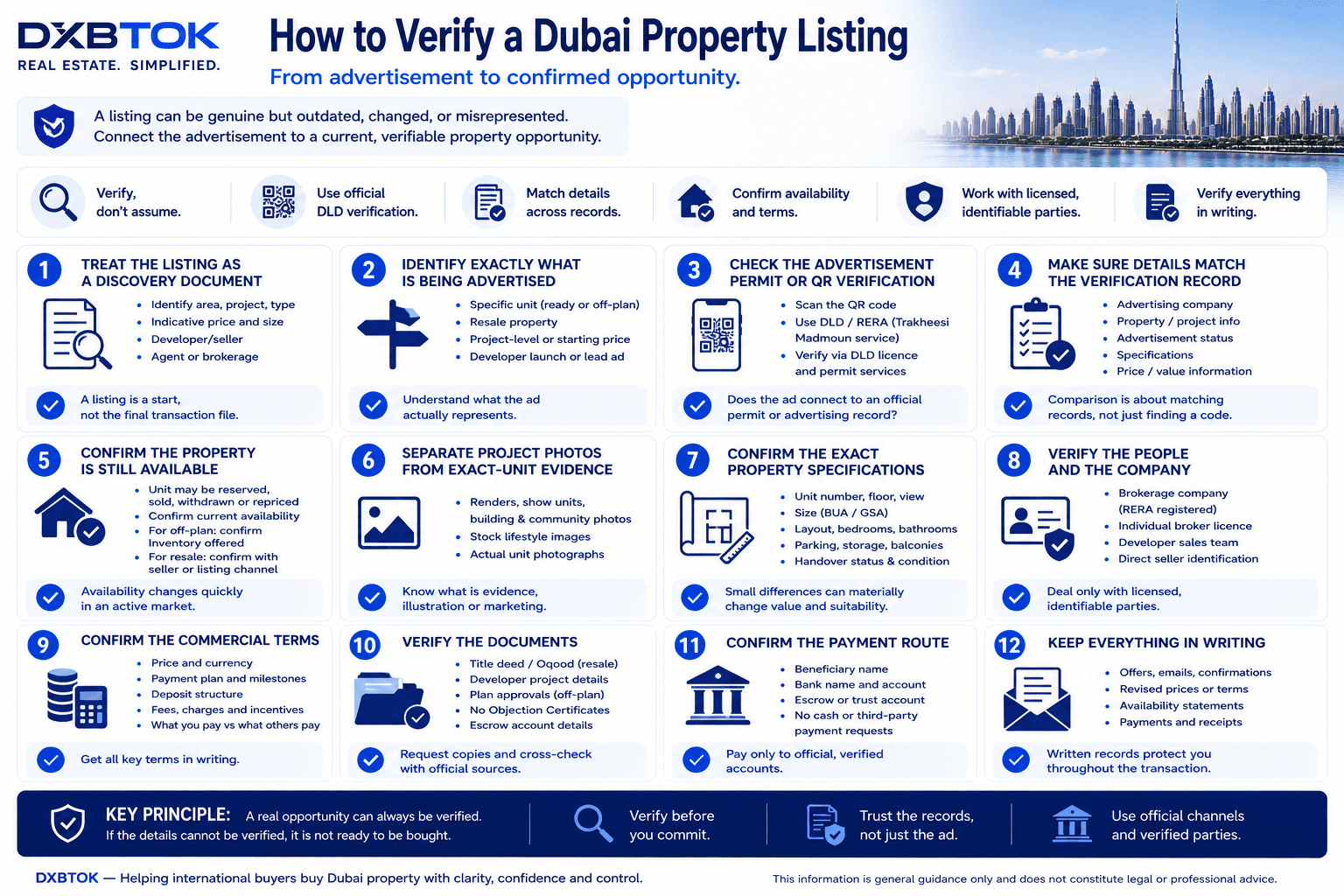
14. Use a listing-verification sequence
A practical buyer workflow is:
Identify what type of listing you are viewing.
Check the advertisement permit or official verification route where applicable.
Match the advertiser and property information.
Confirm the property or unit is still available.
Verify the broker, developer or seller route.
Reconfirm the exact property specifications.
Reconfirm the current price and payment terms.
Move into full offer, document and payment verification only after the listing is consistent.
This keeps the verification proportional to the stage of the buyer journey.
You do not need a complete legal review for every property you scroll past.
You do need stronger evidence before a listing becomes a serious purchase candidate.
15. A verified listing is not the same as a verified purchase
This is the most important distinction.
Once a property becomes a serious candidate, the next step is to verify the Dubai property offer before sending money.
A listing check establishes whether the advertisement appears connected to a real, current and identifiable property opportunity.
The next stages still include:
offer verification
party verification
document review
contract review
payment verification
registration and transaction checks
For the wider transaction review, use the Dubai property buyer due diligence checklist.
Each stage answers a different question.
Do not ask one verification step to prove the entire transaction.
Final takeaway
A professional-looking Dubai property listing should never be trusted solely because the photography, branding or sales presentation looks convincing.
But verification does not have to begin with the assumption that every listing is fraudulent either.
A stronger approach is systematic.
Identify what is actually being advertised.
Check the advertisement permit or official verification record where applicable.
Match the property and advertising company information.
Confirm current availability, exact specifications, price and payment terms.
Then move from listing verification into the deeper offer, document and payment checks required before committing.
The objective is to turn an online advertisement into a property opportunity you can identify, verify and evaluate with evidence.
Found a Dubai property you want to verify?
DXBTOK helps international buyers review selected Dubai property opportunities and move from online discovery toward a more structured purchase decision with clearer property, partner and transaction checks.
Start your Dubai property review at DXBTOK.com.
Related DXBTOK guides
How to Verify a Dubai Real Estate Broker →
Dubai Broker BRN Number Explained: How Buyers Can Check Credentials →
How to Verify a Dubai Property Developer →