Branded residences and serviced apartments in Dubai can offer similar hospitality-style experiences while having different ownership and operating structures. This guide helps international buyers compare the exact property interest, brand or operator role, services, rental and management arrangements, owner-use conditions, recurring costs and resale considerations before choosing between the two.
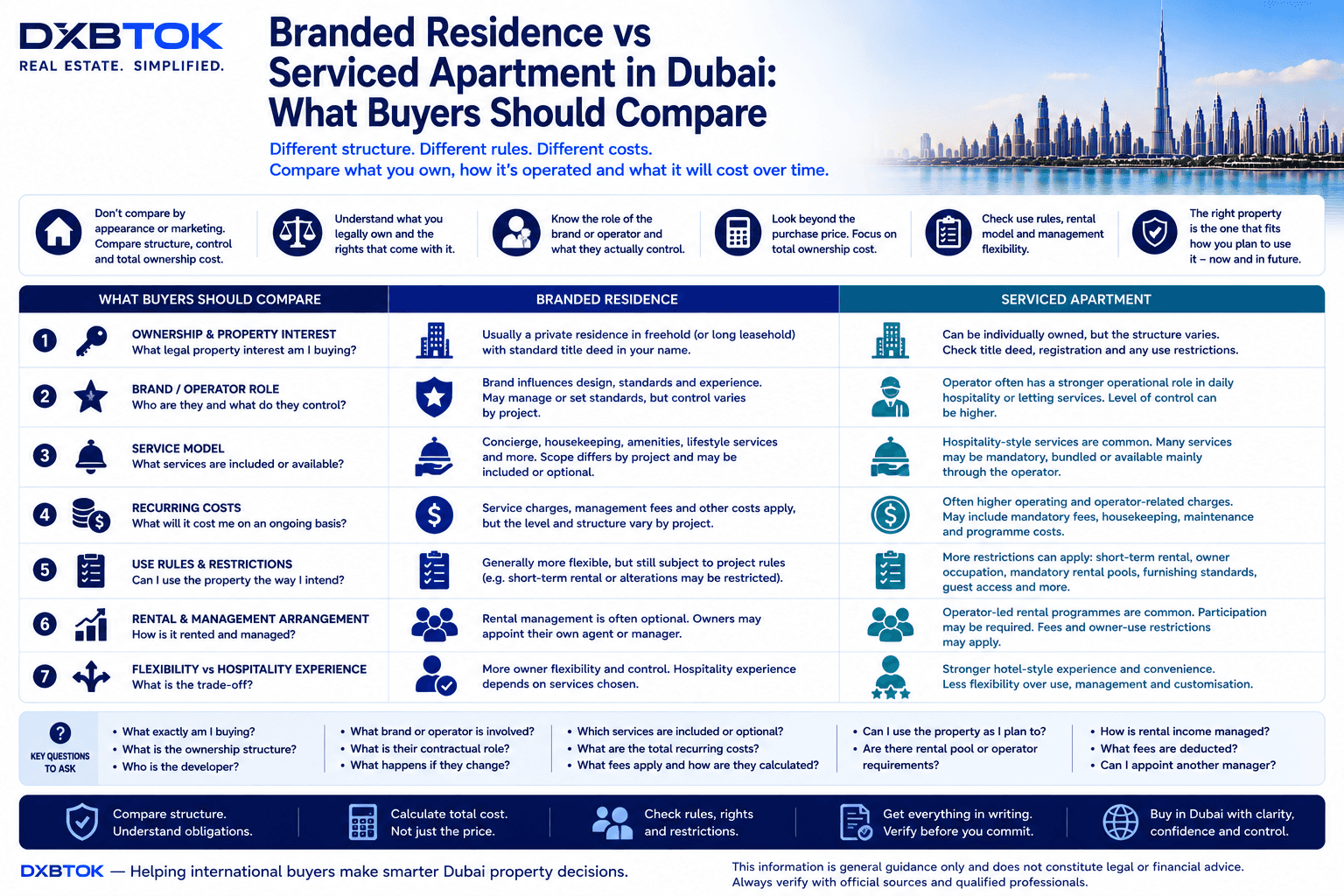
Branded Residence vs Serviced Apartment in Dubai: What Buyers Should Compare
A branded residence and a serviced apartment in Dubai can look similar at first glance.
Both may offer premium interiors, hospitality-style services, concierge support, housekeeping options, shared amenities or association with a hotel or lifestyle brand.
But for a buyer, the important question is not whether the two products look similar.
It is:
“What exactly am I buying, who controls the service model, what rules apply, and what will ownership cost me over time?”
The answer can differ substantially from one project to another.
That is why buyers should compare the ownership and operating structure rather than relying on appearance or marketing language alone.
1. Start with the ownership question
The first comparison should be simple:
What legal property interest am I actually buying?
A branded residence is generally marketed as a privately owned residence associated with a recognised brand.
A serviced apartment may also be individually owned, but the term itself can describe different property and operating models.
Do not assume that “serviced apartment” tells you everything about:
ownership rights
registration structure
use conditions
rental arrangements
management obligations
The exact project documents and property structure matter more than the label.
2. Ask what role the brand or operator actually has
In a branded residence, the brand may influence design, service standards, management, resident experience or marketing.
In a serviced apartment, an operator may play a more operational role in day-to-day hospitality or letting services.
But neither description should be assumed.
Buyers should ask:
Which brand or operator is involved?
What is its contractual role?
Does it manage the building or only provide certain services?
Does it control rental operations?
What happens if the operator or brand relationship changes?
For a broader branded-property review, buyers can use the Dubai branded residences buyer guide.
The name on the building is less important than understanding what that party is actually responsible for.
3. Compare the service model
Both property types can include services.
The difference is often in the scope, frequency and contractual structure of those services.
Possible services can include:
concierge
housekeeping
maintenance coordination
room service or hospitality services
valet parking
resident lounges
fitness and wellness facilities
rental or letting management
Ask which services are:
included
optional
charged separately
available only through the operator
A premium service menu can be attractive, but the buyer should understand how it affects ownership costs and control.
4. Compare recurring costs, not only the purchase price
The purchase price can be only the beginning of the comparison.
Premium services and operating standards can create additional ongoing costs.
These may include:
service charges
management fees
operator-related charges
housekeeping packages
maintenance obligations
furniture replacement requirements
rental-management fees
The relevant question is not simply:
“Which one costs less to buy?”
It is:
“For branded projects specifically, review the dedicated guide to branded residence fees and ownership costs in Dubai.”
“What is the total ownership-cost structure for the way I plan to use the property?”
5. Check whether the property can be used the way you intend
Use rules can matter more than buyers expect.
A property designed around a hospitality or managed model may have different restrictions from a more conventional residential apartment.
Ask whether the property has rules affecting:
owner occupation
short-term rental
long-term rental
mandatory rental pools
operator participation
minimum furnishing standards
alterations or renovations
guest access
A property can be attractive and still be unsuitable if the operating rules conflict with the buyer’s intended use.
6. Understand the rental and management arrangement
Some buyers are attracted to serviced or branded properties because they expect easier rental management.
That may be relevant, but the arrangement should be understood precisely.
Ask:
Is there a rental-management programme?
Is participation optional or required?
Who manages the property?
How is income calculated?
What fees are deducted?
Can the owner appoint another manager?
Are there owner-use restrictions?
The existence of a professional operator does not by itself tell the buyer whether the rental model is suitable.
7. Separate hospitality experience from ownership flexibility
One property may offer a stronger hotel-style experience.
Another may give the owner more flexibility over furnishing, management or use.
Neither is automatically better.
The trade-off depends on the buyer.
A buyer who values convenience may prefer more operating support.
A buyer who values control may prefer fewer restrictions.
The right comparison is therefore not simply luxury versus non-luxury.
It is service intensity versus ownership flexibility.
8. Compare the contractual structure
A branded or serviced property may involve more than one important agreement.
Depending on the project, the buyer may need to review:
the main property purchase agreement
management agreements
brand-related terms
rental or letting agreements
service agreements
building rules
Buyers should understand how these documents work together.
The dedicated guide to branded residence contracts in Dubai explains the additional agreements buyers may encounter in branded ownership.
The most important obligations may not all sit in one contract.
9. Check whether the brand relationship is permanent
Brand association can influence the buyer’s perception of value.
But buyers should understand what happens if the brand or operator relationship changes in the future.
Useful questions include:
How long is the current brand or operator agreement expected to run?
Who has the right to appoint or replace the operator?
What happens to services if the relationship changes?
Does the property remain subject to the same operating standards?
The buyer should not assume that a brand relationship is automatically permanent.
10. Compare furnishing obligations
Serviced apartments and branded residences can both involve furnishing standards.
Some projects may require owners to maintain a particular interior specification, especially where rental or hospitality operations are involved.
Ask:
Is the property delivered furnished?
Who owns the furniture?
Can the owner replace it freely?
Are replacement cycles required?
Who pays for replacement items?
Does rental participation depend on maintaining the approved standard?
Furnishing rules can affect both operating flexibility and long-term ownership costs.
11. Compare owner access and personal use
For buyers intending to use the property themselves, owner-access rules can be critical.
Some managed or hospitality-oriented arrangements may place conditions on:
when the owner can occupy the property
how stays are booked
whether rental commitments take priority
guest access
housekeeping or service requirements
Buyers should understand whether the property works as a genuine personal residence, an income-focused managed unit or a mixture of both.
12. Compare resale flexibility
The ownership model can also affect the future resale process.
Before buying, ask whether resale may involve:
operator approval
brand-related conditions
mandatory management arrangements
transfer fees
buyer eligibility requirements
specific resale procedures
For branded properties, buyers can also review what may matter when reselling a branded residence in Dubai.
A property that is easy to buy is not automatically equally simple to resell.
13. Compare the buyer’s actual objective
The right choice depends heavily on what the buyer wants from the property.
A branded residence may suit someone who values:
brand positioning
resident services
design standards
managed lifestyle
premium owner experience
A serviced apartment may appeal to a buyer who prioritises:
hospitality-style operations
professional management
rental convenience
shorter-stay use cases
But these are only general tendencies.
The exact project structure must still be checked.
14. Do not compare two labels — compare two actual properties
This is one of the most important points.
The labels “branded residence” and “serviced apartment” are not enough to make the decision.
Two projects in the same category can have very different:
ownership structures
service levels
fees
operator agreements
rental rules
resale conditions
For another premium-property comparison, review branded residence vs luxury apartment in Dubai.
Compare the actual documents, costs and operating model of the two specific properties.
15. Use a five-part comparison framework
A practical buyer comparison is:
Ownership — what exactly do I own?
Operator / Brand — who does what?
Services — what is included and what costs extra?
Use Rules — how can I occupy, rent or manage the property?
Ongoing Costs — what will ownership require after purchase?
If these five areas are clear, the buyer is comparing the underlying structure rather than the marketing category.
16. Verify the documents before relying on the lifestyle promise
Marketing material may focus on concierge service, hotel-style living, recognised branding or premium amenities.
Those features can be meaningful.
But the buyer should still confirm what is actually reflected in:
the property documents
management arrangements
service schedules
fee structures
use conditions
The lifestyle promise should connect to a real ownership structure.
Final takeaway
A branded residence and a serviced apartment in Dubai can offer similar visual or hospitality experiences while giving the buyer very different ownership and operating arrangements.
The useful comparison is not:
“Which one looks more luxurious?”
It is:
“Which ownership, service and operating structure fits the way I want to use the property?”
Compare the exact property, operator or brand role, services, use restrictions, management model, ongoing costs and resale conditions.
Buy the structure that fits your objective — not simply the label that sounds more premium.
Comparing premium Dubai property options?
DXBTOK helps international buyers compare selected Dubai property opportunities with clearer information around ownership structure, services, fees, use conditions and the transaction process.
Start your Dubai property review at DXBTOK.com.
Related DXBTOK guides
Branded Residences Dubai Buyer Guide →
Branded Residence vs Luxury Apartment in Dubai: What Buyers Should Compare →
Branded Residence Contracts in Dubai: What Buyers Should Review →
Hidden Fees and Ownership Costs in Dubai Branded Residences →
Reselling a Branded Residence in Dubai: What Buyers and Owners Should Know →