Branded Residence vs Luxury Apartment in Dubai: What Buyers Should Compare


Compare branded residences and luxury apartments in Dubai across property quality, brand involvement, services, contracts, recurring costs, operating rules, rental use and resale considerations.
Branded Residence vs Luxury Apartment in Dubai: What Buyers Should Compare
A branded residence and a luxury apartment in Dubai can look similar at first glance.
Both may offer:
premium locations
high-end finishes
concierge-style services
pools, gyms and lounges
strong architecture
prestigious developers
premium pricing
But the ownership proposition can be different.
A branded residence adds another layer:
the brand relationship
That can affect services, standards, fees, operating rules, marketing positioning and the buyer's expectations after purchase.
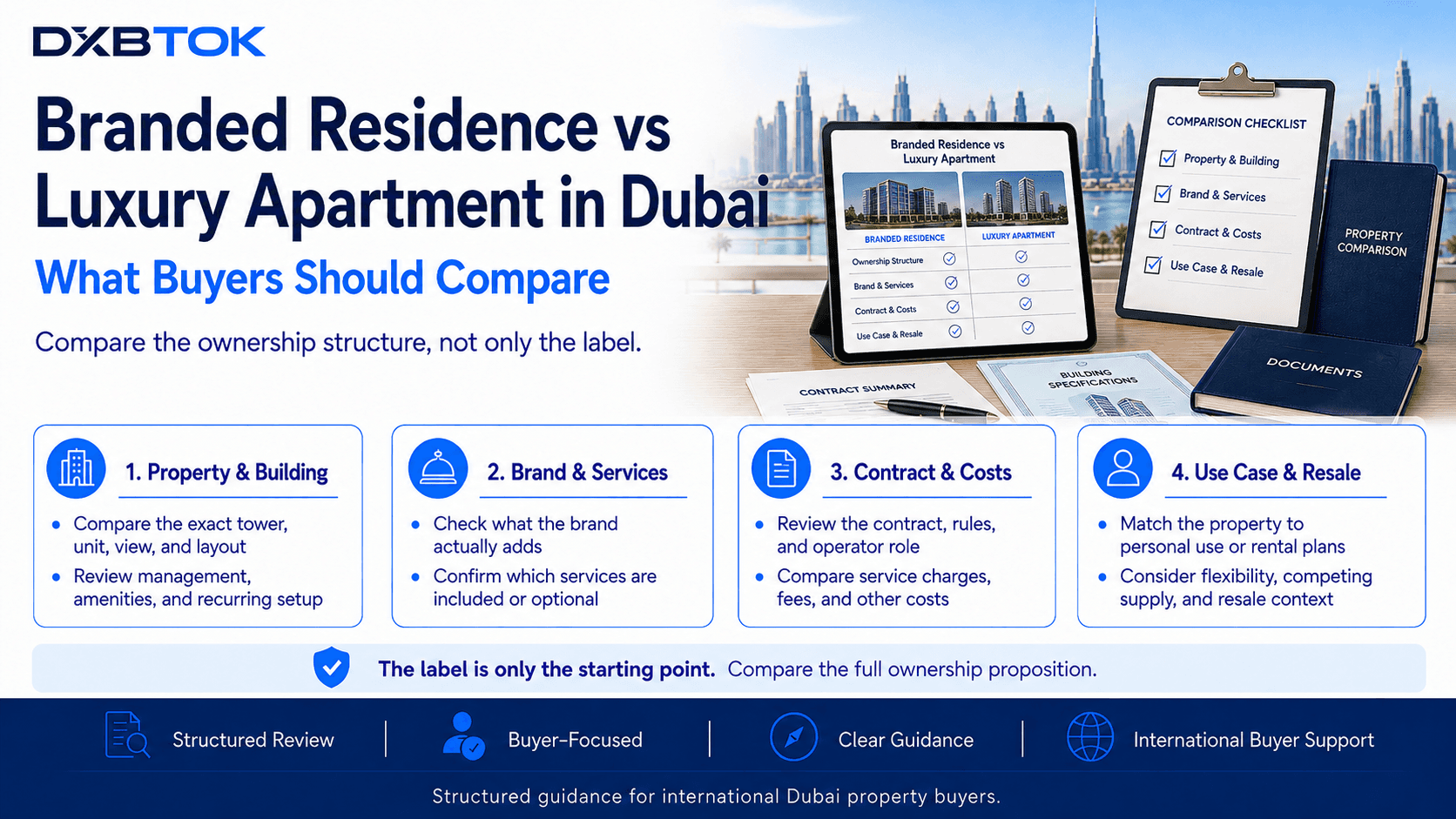
A useful comparison framework is:
property → building → brand → services → contract → recurring costs → use case → resale
The important question is not simply:
“Which one is more luxurious?”
It is:
“What am I actually paying for, and which ownership structure fits the way I intend to use the property?”
1. Start by separating luxury from branding
A luxury apartment is defined mainly by the quality and positioning of the property.
That can include:
location
design
materials
views
amenities
building quality
unit size
privacy
service level
A branded residence adds an identifiable external brand to the property proposition.
That brand may be connected to:
hospitality
fashion
automotive
design
lifestyle
another premium consumer sector
The presence of a brand does not automatically make the underlying property better.
It creates a different proposition that should be reviewed separately.
2. Ask what the brand actually contributes
Do not stop at the brand name.
Ask what the brand contributes to the residence.
Possible contributions may include:
design direction
service standards
operating procedures
concierge experience
shared facilities
owner privileges
hospitality integration
brand-specific interiors
quality standards
marketing position
The exact contribution varies by project.
A buyer should understand what exists in the actual project rather than relying on assumptions based on the brand's reputation elsewhere.
3. A luxury apartment can still offer hotel-style services
Branding and service level are not the same thing.
A non-branded luxury apartment may still provide:
concierge
valet
security
housekeeping options
private lounges
wellness facilities
high-end pools
resident services
This is why the comparison should not become:
branded = serviced
and
luxury apartment = unserviced
The real question is what services are actually included, optional or unavailable in each property.
4. Compare the exact building, not the category label
Two branded residences can be very different from each other.
Two luxury apartment buildings can also be very different.
Compare the exact:
development
tower
unit
floor
layout
view
service structure
management setup
recurring-cost structure
The category gives you a starting point.
The building gives you the ownership reality.
5. Understand the brand relationship
A branded residence may involve several different parties.
These can include:
developer
property owner
brand
operator
building manager
hospitality operator
owners' management structure
Do not assume that the brand is the developer.
Do not assume that the brand will operate the building forever.
Do not assume that every service associated with the brand is included in your ownership.
Use the branded residence buyer guide when reviewing the broader ownership structure.
6. Check whether the brand and operator are the same
In some projects, the brand and operator may be closely connected.
In others, they may be separate.
That matters because:
brand identity
and
day-to-day operation
are not necessarily the same thing.
The buyer should understand who is responsible for:
services
building operations
owner communication
maintenance coordination
hospitality functions
common-area standards
7. Compare what is contractual with what is promotional
A branded residence can be marketed around a strong lifestyle story.
That may include references to:
brand heritage
hospitality
signature services
design philosophy
owner privileges
exclusive experiences
But a buyer should separate marketing language from contractual commitments.
Check what is actually reflected in:
reservation documents
SPA
management documents
service descriptions
project disclosures
owner rules
fee schedules
8. Review the contract structure carefully
If the property is branded, the contract package may contain provisions relating to the brand, operator, services or management structure.
The buyer should understand what the documents say about:
brand involvement
service scope
operator responsibilities
owner obligations
fees
usage restrictions
future changes
termination or replacement provisions where applicable
Use the branded residence contracts guide for the deeper contract-review layer.
9. Compare recurring ownership costs
A branded residence may carry a more complex operating structure than a conventional luxury apartment.
That does not automatically mean the costs are excessive.
It means the buyer should understand what they are paying for.
Compare:
service charges
management fees
hospitality-related fees where applicable
optional service fees
maintenance
sinking or reserve-related costs where applicable
utilities
furnishing upkeep
Do not compare purchase price alone.
10. Ask what the recurring fees actually fund
A higher recurring cost can sometimes support a higher service level.
But the buyer should know what the fee covers.
Possible items may include:
concierge
security
common-area operations
amenity maintenance
branded service standards
hospitality support
resident facilities
management
staffing
Use the branded residence fees and ownership costs guide when comparing the recurring-cost layer.
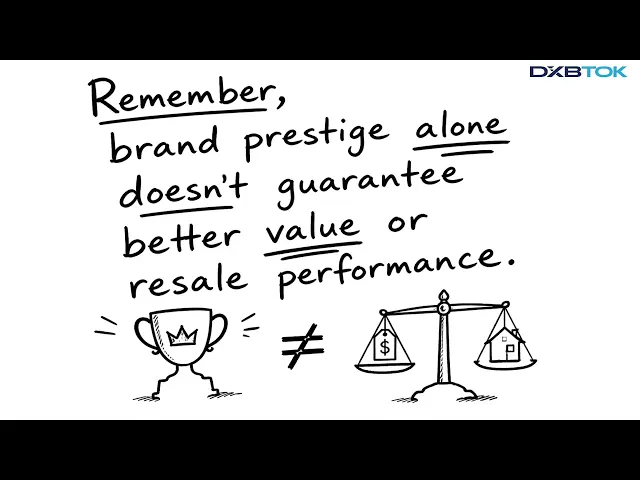
11. Do not assume brand prestige guarantees resale performance
A strong brand may help a property stand out.
But resale performance depends on more than branding.
Factors can include:
location
supply
unit quality
view
building condition
service quality
recurring costs
resale competition
buyer demand
broader market conditions
Brand recognition is one factor.
It is not a guaranteed resale outcome.
12. Compare scarcity carefully
Some branded projects may have relatively limited supply.
That can increase distinctiveness.
But scarcity alone does not make a property desirable.
Ask:
Is the project genuinely differentiated?
Is the unit itself attractive?
Are there competing branded projects nearby?
Are there stronger non-branded luxury alternatives?
Will future supply change the comparison?
13. Consider how important the brand is to your own use case
If you plan to live in the property, the brand may matter because of:
service experience
design
hospitality
status
convenience
consistency
If you are buying mainly for rental use, you may care more about:
tenant profile
rental restrictions
operating costs
furnishing standards
management
location
unit efficiency
The right answer can differ by buyer.
14. Compare personal use restrictions
Some branded or hospitality-linked residences may have more detailed operating or usage rules.
Before buying, understand whether there are rules affecting:
renovation
furnishing
leasing
short-term use
guest access
owner alterations
signage
service providers
property management
Do not assume that premium ownership means unlimited flexibility.
15. Compare rental flexibility
If rental use matters, ask how each property works for your intended rental model.
Check:
long-term rental suitability
short-term use where permitted
operator involvement
management options
furnishing requirements
access procedures
tenant rules
owner-use restrictions where relevant
A property can be luxurious but still be operationally inconvenient for your rental plan.
16. Compare the service model
A branded residence may offer a more structured service proposition.
A luxury apartment may offer a simpler one.
Neither is automatically better.
Ask:
Which services are included?
Which are optional?
Which require separate payment?
Who delivers them?
Are they available to all owners?
Are they guaranteed by contract or simply part of current operations?
17. Compare privacy and building traffic
Hospitality-linked buildings may have a different operating atmosphere from a purely residential luxury tower.
Depending on the project, consider:
guest movement
hotel visitors
restaurant traffic
event activity
lobby usage
shared facilities
resident-only zones
Some buyers value the energy.
Others prefer a quieter residential environment.
18. Compare amenity access carefully
A branded residence may be associated with attractive hospitality amenities.
But buyers should confirm exactly which facilities residents can use.
Ask whether access is:
included
paid
restricted
shared
resident-only
subject to operating rules
subject to future changes
Do not assume that every hotel or brand facility shown in marketing is part of the ownership package.
19. Review furnishing obligations
Some branded residences may have stronger expectations around interior consistency.
That can affect:
furniture choices
renovation
replacement items
rental furnishing
approved suppliers
design changes
A conventional luxury apartment may give the owner more freedom.
But this depends on the exact building and rules.
20. Compare maintenance complexity
Premium finishes can increase maintenance complexity in both categories.
Consider:
specialist materials
custom joinery
imported fixtures
smart-home systems
branded furniture
bespoke lighting
integrated appliances
The more specialized the property, the more important it is to understand replacement and repair processes.
21. Compare management quality, not just brand quality
A globally recognized brand does not remove the need for good local operations.
The buyer should still assess:
building management
response times
maintenance
owner communication
access control
cleanliness
common-area condition
staffing
The ownership experience is created locally.
22. Ask what happens if the brand relationship changes
This is an important branded-residence question.
Do not assume that the current brand relationship is permanent under every circumstance.
Review the relevant documents and understand how they address:
duration
termination
replacement
operator change
service change
branding rights
owner impact
The answer should come from the actual project documentation.
23. Compare value beyond the logo
A brand name may carry real value for some buyers.
But the buyer should identify what that value consists of.
For example:
better service
stronger design
stronger recognition
operational consistency
owner privileges
premium positioning
If the buyer cannot identify the practical benefit, the brand premium may be difficult to evaluate.
24. Compare the unit itself
Do not let the brand distract from basic property quality.
Compare:
internal layout
usable space
storage
view
orientation
floor
privacy
noise
balcony
parking
lift access
A stronger unit in a non-branded luxury building can be more suitable than a weaker unit in a branded project.
Use the luxury apartments Dubai guide when reviewing the non-branded premium-apartment side of the comparison.
25. Compare the location independently
The brand does not change the location.
Review:
access
surrounding development
transport
retail
beach or waterfront access
business districts
schools where relevant
future construction
local supply
The best property category still needs the right location for the buyer.
26. Compare the total ownership proposition
The clean comparison is not:
brand vs no brand
It is:
property quality + services + contract + recurring costs + operating rules + location + use case
That gives the buyer a more complete view.
27. Use a side-by-side comparison
Before deciding, compare both properties using the same questions.
Property
Which unit is better?
Which layout is more practical?
Which view and floor are stronger?
Building
Which building is better operated?
Which amenities actually matter?
Which environment suits me?
Brand
What does the brand actually contribute?
Is that contribution documented?
Services
What is included?
What costs extra?
Who delivers it?
Costs
What are the recurring charges?
What do those charges fund?
Use
Which property fits personal use?
Which fits rental use?
Which gives me the flexibility I need?
Resale
How broad is the future buyer pool?
What would a future buyer be paying a premium for?
28. Verify branded claims before paying a premium
If the branded residence is materially more expensive than the luxury apartment, identify what explains the difference.
Then verify the claims supporting that premium.
Use the branded residence claims verification guide to test the relationship between the developer, brand, operator, services and contractual documents.
Branded Residence vs Luxury Apartment Checklist
Branded Residence
Brand relationship understood
Operator identified
Service scope reviewed
Contract structure reviewed
Recurring fees understood
Usage rules reviewed
Brand-change provisions checked
Actual owner benefits identified
Luxury Apartment
Building quality reviewed
Service level reviewed
Management quality checked
Amenities compared
Recurring costs reviewed
Unit flexibility considered
Rental suitability assessed
Both
Unit compared
Location compared
Total ownership cost compared
Management compared
Resale considerations reviewed
Intended use matched to property
How DXBTOK Approaches the Comparison
The decision should not be:
famous brand = better property
or
non-branded = better value
A stronger process is:
compare the exact unit → understand the service structure → review the brand relationship → compare recurring costs → review operating rules → match the property to your use case
The objective is to understand what the premium actually buys.
Final Takeaway
A branded residence and a luxury apartment can both be strong Dubai property options.
The difference is not simply the logo.
A branded residence can add another layer of service, identity, operating structure and contractual complexity.
A luxury apartment may offer comparable property quality with a simpler ownership proposition.
The key question is:
“Which exact property gives me the ownership experience, flexibility and cost structure that fits the way I intend to use it?”
Need Help Comparing Branded Residences and Luxury Apartments in Dubai?
DXBTOK helps international buyers compare Dubai property options by looking beyond marketing labels and reviewing the property, service model, recurring costs, ownership structure and practical use case.
Contact DXBTOK and let us help you compare the options more clearly before moving forward.
Related DXBTOK guides
Branded Residences in Dubai: Buyer Guide →