

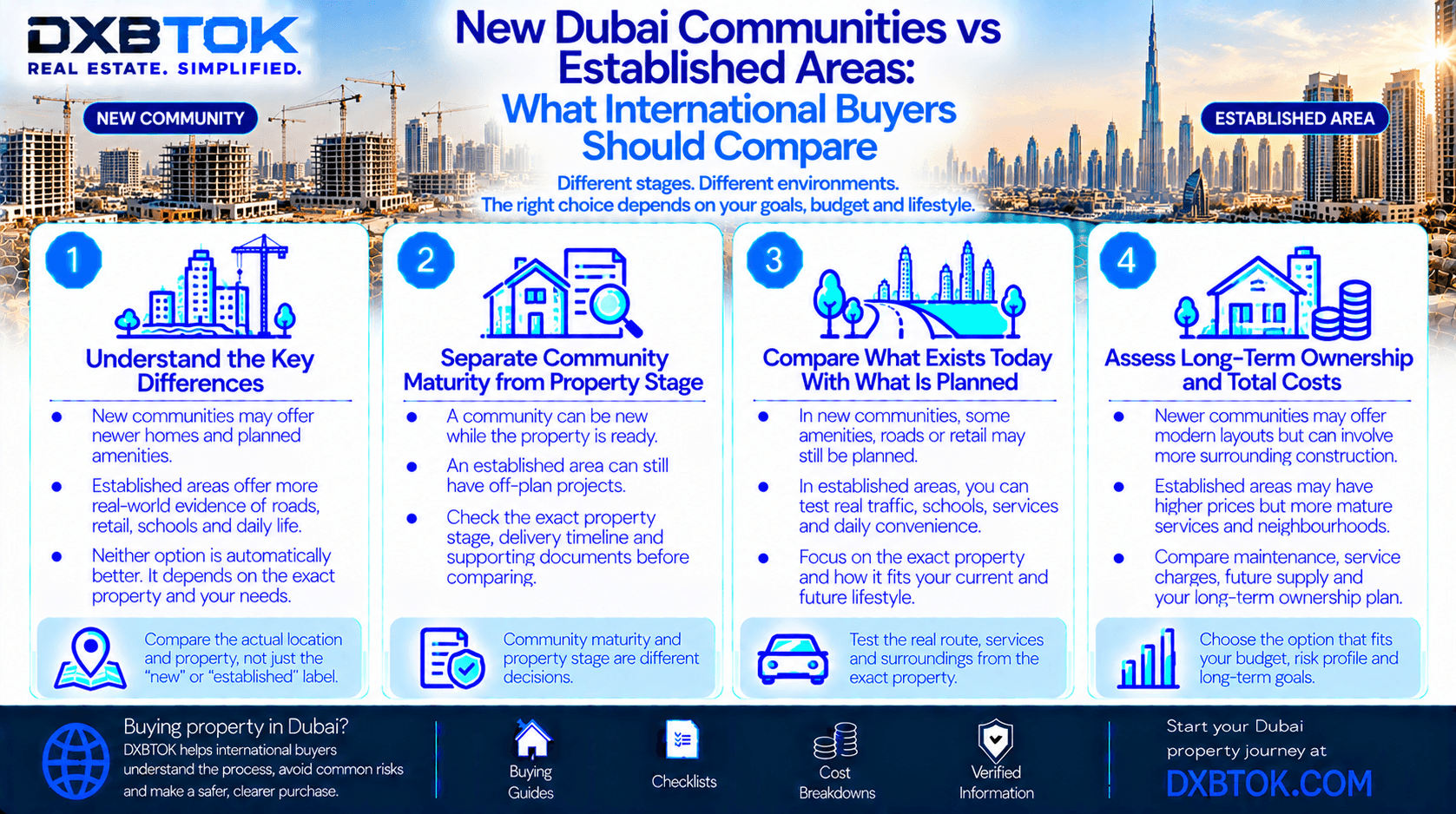
New Dubai communities can offer newer homes, fresh amenities and coordinated master planning, while established areas provide stronger evidence around access, schools, retail, building performance and day-to-day convenience. International buyers should separate community maturity from the off-plan-versus-ready decision, then compare the exact property, current surroundings, future development, recurring costs, ownership horizon and total budget before deciding which option better fits their needs.
New Dubai Communities vs Established Areas: What International Buyers Should Compare
Dubai buyers often compare newer master-planned communities with established areas that already have mature roads, retail, schools, buildings and day-to-day activity.
Neither option is automatically better. A newer community may offer newer homes, fresh amenities and a coordinated master plan, while an established area may offer stronger evidence about access, services, building performance and how the location works in normal daily life.
For an international buyer, the useful question is which exact property offers the better balance between current practicality and future potential for the buyer’s own use, budget and ownership horizon.
Community maturity and property stage are different decisions. A new community can contain ready homes, and an established area can still contain off-plan projects.
1. What Is the Main Difference Between a New Community and an Established Area?
The main difference is the amount of real-world evidence already available.
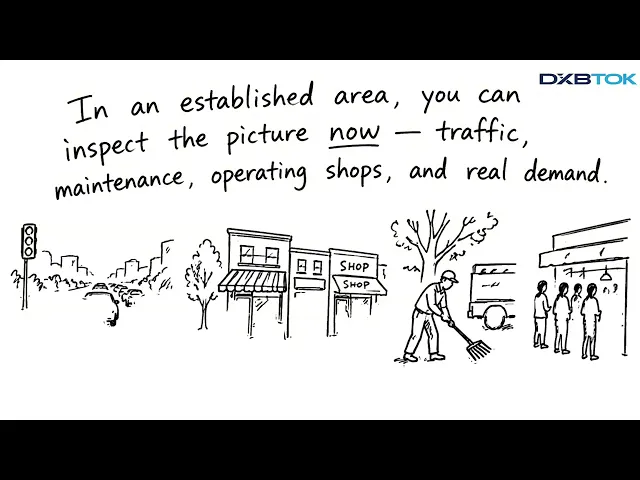
In an established area, buyers can usually judge existing roads, traffic patterns, retail, schools, public spaces, neighbouring buildings and operating service standards more directly.
In a newer community, part of the decision may depend on future phases, planned amenities, changing road access, landscaping maturity and new supply that has not yet been delivered.
Dubai Property Area Selection explains how buyers can compare access, community maturity, surroundings and property fit before choosing between Dubai locations.
2. Do Not Confuse Community Maturity With Off-Plan vs Ready
A community can be new while the property itself is ready, and an established area can still have off-plan inventory.
Community maturity describes the surrounding location. Property stage describes whether the specific home is completed or still under development.
Dubai Off-Plan vs Ready Property explains how buyers can compare construction stage, inspection evidence, payment timing and uncertainty separately from the maturity of the area itself.
3. Compare What Exists Today With What Is Still Planned
The more the purchase depends on future delivery, the more carefully the buyer should separate current evidence from expectations.
In a new community, future retail, schools, parks, roads or neighbouring phases may improve the area over time, but they should not be treated as if they already exist.
A strong property should remain understandable even if some surrounding development takes longer than expected.
4. Established Areas Give Buyers More Operating Evidence
Mature areas usually make it easier to judge how the location works on an ordinary weekday.
Buyers can inspect real traffic, actual walking routes, building age, service quality, parking pressure, noise, retail convenience and the condition of surrounding streets.
That evidence can reduce some uncertainty, but it does not automatically make every property in an established area a strong purchase.
5. New Communities Can Offer Newer Housing Stock
Newer communities often give buyers access to newer buildings, layouts and community design.
That can mean newer finishes, newer building systems, more recent amenity planning and less immediate renovation work.
Buyers should still test whether the home itself is practical, well designed and fairly priced rather than assuming that newer automatically means better.
6. Road Access Should Be Judged at the Exact Property
Future road plans are useful context, but the buyer lives with the access that exists when the property is used.
Test the current route to work, schools, airports, main highways and regular destinations. In developing communities, also understand whether nearby construction could temporarily affect access.
In established areas, mature roads can be an advantage, but existing congestion may already be part of normal daily life.
7. Schools, Retail and Services Need Different Evidence
Planned amenities and operating amenities should not be valued in the same way.
A functioning school, supermarket, clinic or retail centre gives direct evidence of daily convenience. A planned facility may still be valuable, but the buyer should understand that timing and final delivery can change.
The strongest location is the one that works for the household’s real routine rather than the one with the longest future-amenity list.
8. Construction Around the Property Can Change the Ownership Experience
New communities may involve several years of surrounding development.
That can affect noise, views, road patterns, dust, privacy and the general sense of completion around the property.
Established areas may have less large-scale construction, but individual plots and redevelopment can still affect the exact building or street.
9. Service Charges and Maintenance Should Be Compared Separately
Newer property can reduce some immediate maintenance exposure, while established property can provide better evidence of actual recurring costs.
In a new building, buyers may not yet have several years of operating history. In an established building or community, existing service standards and recurring expenses can often be assessed more directly.
The cost advantage depends on the exact property, not on whether the area is simply new or established.
10. Price Premiums Need a Clear Reason
A buyer should understand what the premium is paying for.
A new-community premium may reflect newer stock, future infrastructure or a stronger master-plan concept. An established-area premium may reflect proven access, mature amenities, centrality, scarcity or a known residential environment.
Compare the exact home with realistic alternatives at the same total budget rather than relying on the area label.
11. Long-Term Ownership Changes the Comparison
The longer the planned holding period, the more important durability becomes.
A new area may mature substantially during ownership, while an established area may offer more predictable surroundings from day one.
Dubai Property for Long-Term Ownership explains how buyers can test location durability, recurring costs, maintenance exposure and future-use flexibility before committing.
12. Future Buyer Appeal Should Be Tested Before Purchase
Community maturity can influence resale appeal, but the exact property still matters more than the label alone.
Future buyers may value a mature area for convenience and proven surroundings, or prefer a newer community for newer stock and design.
Dubai Property Resale explains how buyers can think about future demand, property condition, competition and exit practicality before buying.
13. Remote Buyers Need Stronger Evidence in Developing Areas
When the buyer is abroad, incomplete surroundings can be harder to judge from marketing material alone.
Remote buyers should understand what is operating now, what is still being built and how the exact property will be managed during the community’s development period.
Clear evidence matters more when the buyer cannot easily revisit the area in person.
14. Compare the Total Cost, Not Only the Entry Price
A lower purchase price can be offset by furnishing, transport, maintenance, service charges or the cost of owning a property that is less convenient for the buyer’s daily life.
Established areas can also carry higher acquisition prices or renovation exposure, so both options should be tested using the same budget assumptions.
Full Cost of Buying Dubai Property explains how international buyers can compare the wider cash requirement beyond the listed property price.
15. Match Community Maturity to the Buyer’s Time Horizon
A buyer who needs immediate convenience may value maturity differently from a buyer who can accept several years of change.
Someone relocating soon, using the home personally or relying on nearby schools and services may prefer stronger current evidence.
A buyer with a longer horizon may accept a less mature environment if the exact property and community still make sense under today’s conditions.
16. Avoid Assuming New Means Growth and Established Means Limited Upside
Community age does not guarantee future performance in either direction.
New supply, entry price, property quality, location, future competition, maintenance, building management and wider market conditions all affect future buyer demand.
The purchase should work without relying on a simple “new equals growth” story.
17. Know What Would Make You Reject Either Option
A strong comparison needs rejection criteria on both sides.
A newer community may be rejected if the purchase depends too heavily on future amenities, uncertain access, surrounding construction or an unsupported premium.
An established area may be rejected if the property is dated, expensive to maintain, poorly managed, inconvenient for the buyer or priced too aggressively relative to better alternatives.
The strongest choice is the exact property that works under realistic conditions today and remains practical for the buyer’s expected ownership period.
Final Takeaway
New Dubai communities and established areas offer different types of evidence, risk and convenience.
New communities can provide newer housing stock and coordinated master planning, while established areas can provide stronger proof of daily access, amenities, operating costs and neighbourhood behaviour.
Compare the exact property, current surroundings, future development, access, recurring costs, ownership horizon and total budget before deciding which level of community maturity fits your needs.
DXBTOK helps international buyers compare selected Dubai property opportunities with clearer information around locations, exact properties, buyer costs and long-term ownership practicalities before moving forward.
Related DXBTOK Guides
Dubai Property for Remote Ownership →
Dubai Property Service Charges Explained for Buyers →
Dubai Property Near Schools: How Buyers Should Judge School Access →
Dubai Hills Estate Property Guide for International Buyers →


