

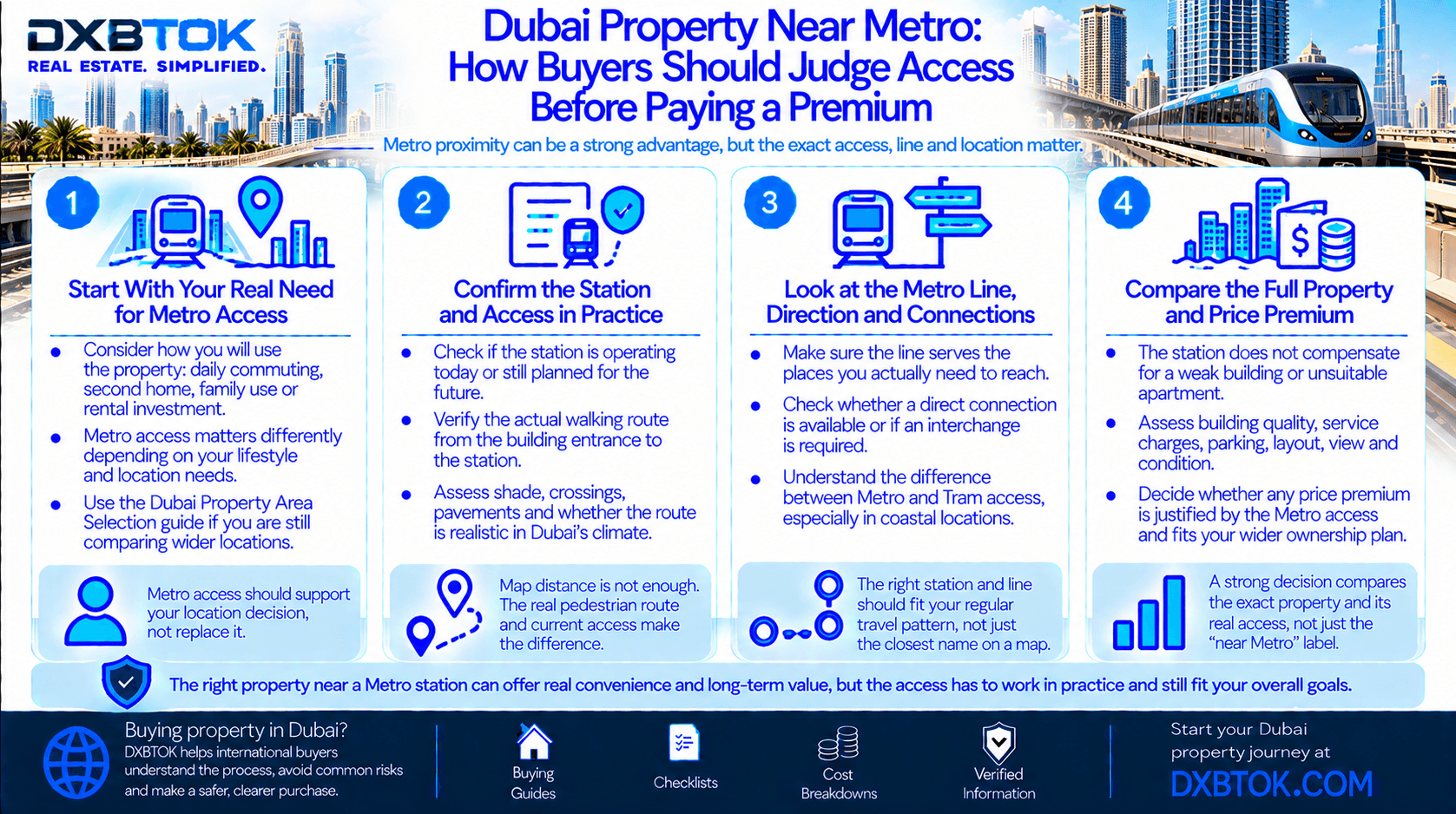
Buying property near the Dubai Metro can improve daily convenience, but distance to a station should not be treated as a standalone reason to buy. International buyers should distinguish operating stations from future infrastructure, assess the practical walking route and useful line connections, understand whether access is direct Metro or involves the Tram, and compare the transport benefit with the building, exact unit, ownership costs and price premium before moving forward.
Dubai Property Near Metro: How Buyers Should Judge Access Before Paying a Premium
“Near the metro” can be a useful property advantage in Dubai, but the phrase is often too broad to support a buying decision on its own.
Two properties may both be marketed as close to public transport while offering very different walking routes, station access, line connections, surrounding streets, noise exposure and daily convenience.
For an international buyer, the stronger question is whether the exact property delivers useful, current transport access that fits the intended ownership plan — and whether any price premium is justified by that access.
Metro proximity is a property feature, not a substitute for choosing the right area, building and exact unit. The access has to work in practice and still make sense alongside the rest of the property.
1. Start With the Buyer’s Real Need for Metro Access
Metro access matters differently depending on how the property will be used.
A daily commuter may care about direct walking access and line connections. A second-home owner may value easy movement without a car. A family may weigh metro access against schools, parking and everyday community convenience. A landlord may care about how useful the connection is to the likely tenant profile.
If the wider location decision is still open, use the Dubai Property Area Selection guide first. Metro access should support the location decision rather than replace it.
2. Confirm Whether the Station Is Operating Today or Planned for the Future
Current transport access and future transport potential are different propositions.
Dubai’s operating Metro network currently includes the Red and Green lines, while additional infrastructure such as the Blue Line is under development.
A property beside an operating station can be judged using the access available today. A property marketed around a future station depends on construction progress, final station position, opening timing and how the surrounding area develops before service begins.
Future transport can strengthen an area, but buyers should not treat planned access as if it already exists.
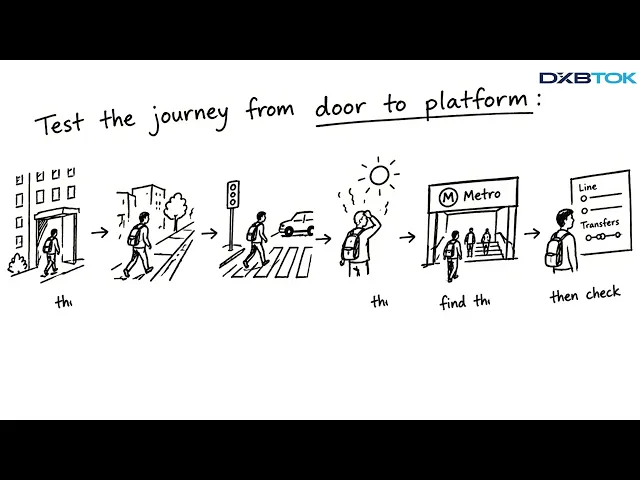
3. Straight-Line Distance Is Not the Same as a Practical Walk
A station may look close on a map while the real pedestrian route is less convenient.
Road crossings, building podiums, large plots, service roads, construction areas and station entrance positions can all affect the actual walking experience.
The useful measure is not simply the distance between two map points. It is whether the route from the building entrance to the station is practical for the owner or likely user.
4. Shade, Heat and Street Design Matter
Dubai’s climate makes pedestrian quality more important than raw distance alone.
A shorter walk with shade, clear pavements and simple crossings may feel more practical than a slightly shorter route exposed to large roads or difficult pedestrian movement.
Buyers should think about whether the connection remains realistic during the hotter parts of the year, not only during a comfortable-weather viewing.
5. The Line and Direction Matter as Much as the Station
Being close to a Metro station is most useful when that line serves the places the resident actually needs to reach.
A property may be close to a station but still require an interchange or a longer journey for the owner’s workplace, university, regular appointments or preferred districts.
Transport convenience should therefore be judged against the likely travel pattern rather than the station name alone.
6. Interchanges Can Improve Access but Add Journey Friction
Dubai’s Red and Green lines connect through interchange stations, which expands the number of destinations accessible by rail.
That can be useful, but a journey requiring an interchange is not the same experience as a direct connection.
For a buyer who expects to use the Metro frequently, the difference between direct access and a regular interchange may matter more than a small difference in walking distance.
7. Distinguish Metro Access From Tram Access
Some Dubai coastal locations are served by the Dubai Tram rather than directly by a Metro station.
The tram can still provide strong public-transport connectivity, particularly where it connects with Metro stations, but the buyer should understand which transport mode is actually serving the property.
A listing that says “close to Metro” should not blur the difference between direct Metro access and a tram-plus-Metro journey.
8. The Building and Exact Unit Still Come First
A convenient station does not compensate for a weak building or unsuitable apartment.
Buyers should still assess building quality, lifts, parking, service charges, unit layout, privacy, view, natural light and condition.
The Dubai Apartments for International Buyers guide covers the wider building-and-unit decision that should sit alongside transport access.
9. Metro Proximity Can Create Trade-Offs
Closer access can be valuable, but it may come with heavier pedestrian movement, road activity, retail traffic or a busier urban environment.
In some buildings, buyers may also care about rail or road noise, privacy, drop-off congestion or the relationship between the station and the building entrance.
The correct balance depends on whether the buyer values maximum transport convenience or a quieter residential setting.
10. A Metro Premium Should Be Explainable
Some properties near stations may command a higher asking price because of convenience, accessibility or stronger demand from buyers and tenants who prefer public transport.
The buyer should still ask what the premium is actually paying for.
If two otherwise comparable properties differ materially in price, the stronger property should offer a meaningful transport advantage rather than only a marketing claim that it is “near Metro.”
11. Ready Property and Off-Plan Property Need Different Evidence
With a ready property, the buyer can assess the current walking route, station entrance, surrounding streets and operating transport connection.
With off-plan property, the building itself may not yet be complete and future roads, landscaping or station infrastructure may still affect the final route.
The Dubai Off-Plan vs Ready Property guide explains the broader evidence difference between completed and future property.
12. Think About Whether the Advantage Will Still Matter Years Later
Metro access can remain useful over a long ownership period, but the property still has to work as the buyer’s needs change.
A property chosen mainly for commuting may later be used as a second home, family residence or rental. Building condition, ownership costs, community quality and future flexibility therefore remain important.
The Dubai Property for Long-Term Ownership guide provides the wider durability framework.
13. Treat Rental and Resale Appeal as a Buyer-Pool Question, Not a Guarantee
Useful Metro access can broaden the pool of people who may consider a property, especially where public transport is important to their daily routine.
That does not guarantee stronger rent, occupancy, resale price or appreciation. Those outcomes still depend on the building, exact unit, price, competing supply, condition and wider market.
The Dubai Property Resale guide covers the broader exit-readiness factors buyers should consider before purchase.
14. Compare Total Ownership Cost, Not Transport Convenience Alone
A lower-transport-cost lifestyle can be attractive, but the property itself may have higher service charges, a higher purchase premium or different maintenance requirements.
The decision should compare the full ownership proposition rather than treating Metro proximity as a standalone financial benefit.
Convenience is valuable only when the overall property still fits the buyer’s budget and ownership plan.
15. Know When Metro Proximity Should Not Drive the Purchase
Metro access may be less important when the buyer expects to drive most of the time, needs a villa-style property, prioritises schools or outdoor space, wants maximum privacy or prefers a lower-density community.
It can also be the wrong reason to pay more when the exact building or unit is weaker than alternatives slightly farther from the station.
The property should earn the shortlist on its overall merits, with transport access adding value rather than carrying the entire decision.
Final Takeaway
Buying Dubai property near the Metro can make daily life more convenient, but “near Metro” should be verified as a real property advantage rather than accepted as a marketing label.
Focus on the current station, practical walking route, line usefulness, interchange needs, building quality, exact unit, ownership costs and whether the transport premium makes sense for the intended user.
The stronger purchase is not simply the property closest to a station. It is the property where transport access strengthens an already sound location, building and unit decision.
DXBTOK helps international buyers compare selected Dubai property opportunities with clearer information around locations, buildings, exact units, buyer costs and remote ownership before moving forward.
Related DXBTOK Guides
Full Cost of Buying Dubai Property: What International Buyers Should Budget →
Buying Dubai Property Without Visiting: What Is Possible? →
Dubai Property Service Charges Explained for Buyers →
Dubai Property Management for Overseas Owners →
Family Property in Dubai: What International Buyers Should Check →


