Dubai Property Management Agreement: What Owners Should Check Before Signing


A Dubai property-management agreement defines the legal and operational authority given to the management company. Remote owners should review the exact parties and property, service scope, exclusions, spending authority, management fees, contractor approvals, reporting obligations, handling of owner funds, leasing powers, DLD/Ejari responsibilities, renewal, termination, liability and exit handover before signing.
Dubai Property Management Agreement: What Owners Should Check Before Signing
A Dubai property-management agreement is the document that defines the legal and operational authority a management company receives over an owner's property.
For an overseas owner, the agreement review is separate from deciding which manager to appoint. If you are still comparing providers, use our Dubai property-manager selection checklist. This guide focuses only on the written contract you are being asked to sign.
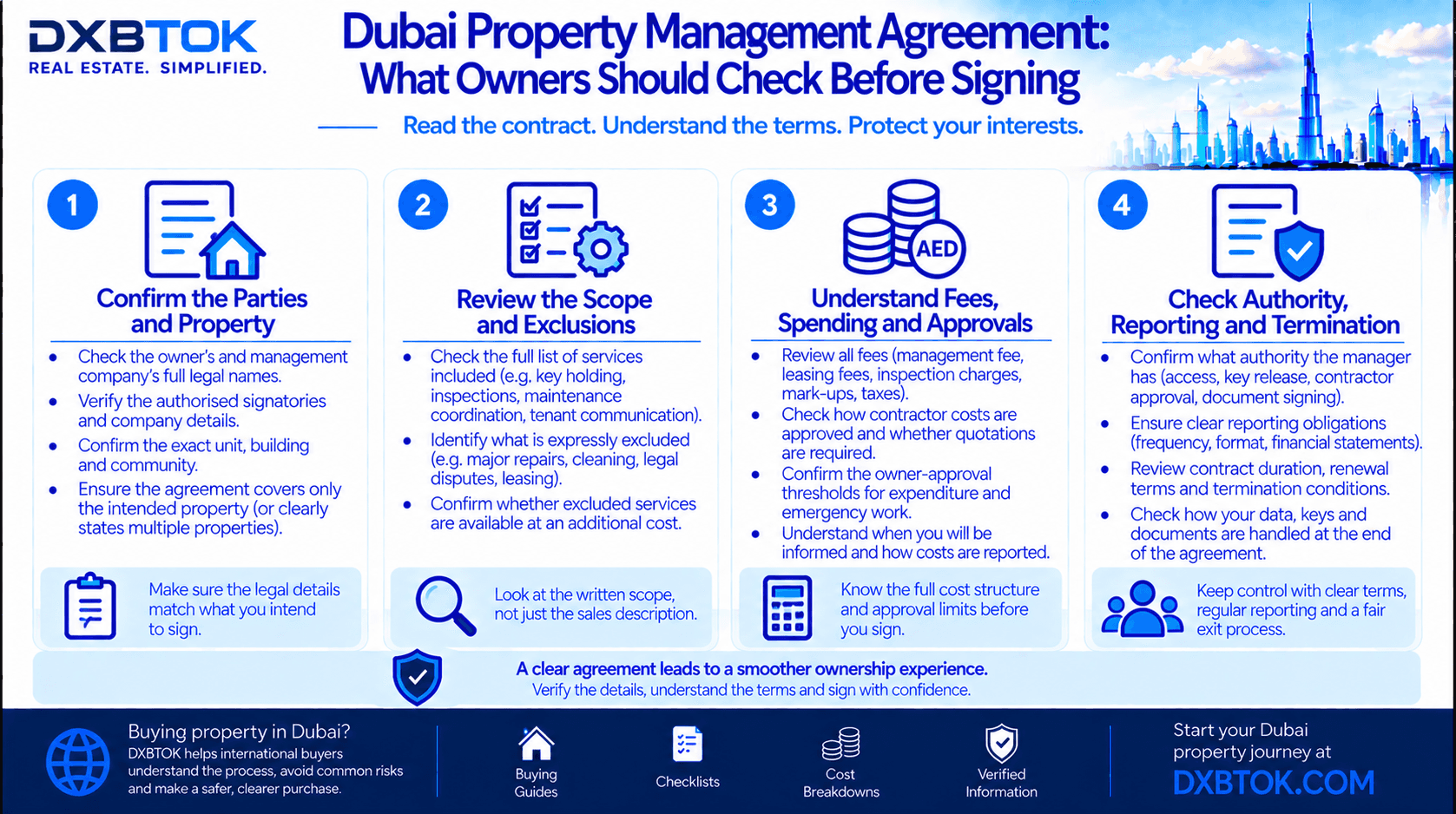
Before signing, read the management agreement clause by clause and make sure the written terms match the authority, controls and reporting structure you intend to give the manager.
1. Confirm the Parties and Property Covered
The agreement should identify the exact legal parties and the property being managed.
owner's full legal name
management company's legal name
any authorised representative signing for either party
unit, building and community
any property or title reference used in the agreement
whether one agreement covers one property or several properties
Do not rely on marketing names or informal descriptions where the legal contract uses a different entity or property description.
2. Read the Contractual Scope, Not the Sales Description
The agreement should state the services the manager is contractually required to provide.
key holding
access coordination
inspections
maintenance coordination
contractor administration
tenant communication
rent or payment administration
move-in or move-out coordination
owner reporting
emergency response
The contract question is whether the written scope matches what the owner expects to be included. For the broader post-purchase operating framework, see our Dubai property management for overseas owners guide.
3. Identify Every Exclusion
Review what the agreement expressly excludes or treats as an additional service.
major repairs
specialist contractors
furnishing replacement
cleaning
insurance claims
legal disputes
leasing work
holiday-home operation
vacancy inspections
emergency call-outs
An excluded service may still be available, but the agreement should make clear whether it requires separate approval, a separate fee or a separate contract.
4. Define the Manager's Authority
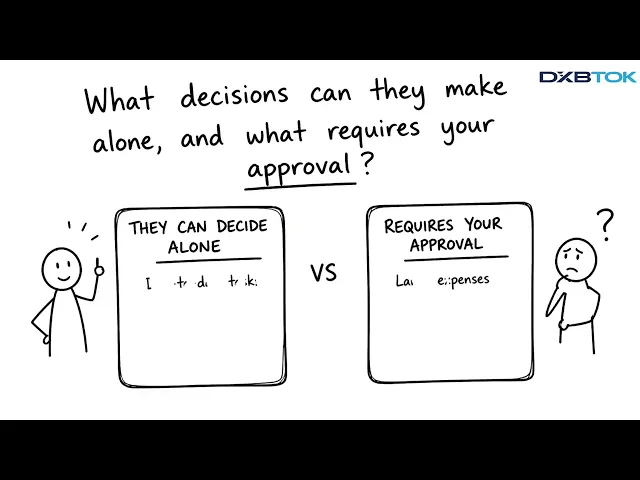
Authority clauses determine what the manager may do without asking the owner each time.
enter the property
release keys or access credentials
authorise contractors
approve minor repairs
communicate with tenants
receive notices
deal with building management
sign or submit documents
receive or administer money
If the agreement gives a representative document-signing or formal execution authority, keep that separate from ordinary operational authority and review it within your wider Dubai property legal checklist for remote buyers.
5. Set Owner-Approval and Spending Thresholds
If the manager may approve expenditure, the agreement should state the financial limits.
the amount that can be spent without prior owner approval
when one or more quotations are required
whether emergency work is exempt from the normal threshold
how emergency expenditure must be reported afterwards
whether recurring costs have separate approval rules
how changes to the spending threshold are made
6. Review Management Fees and Mark-Ups
Do not stop at the headline management fee.
fixed management fees
percentage-based fees
leasing or renewal fees
inspection charges
administration charges
maintenance-coordination fees
emergency charges
contractor mark-ups
termination charges
taxes or other amounts added to the stated fee
Where third-party costs are passed through to the owner, check whether the manager may add a margin, commission or coordination fee.
7. Check How Contractor Costs Are Contractually Approved
The agreement should explain how third-party work is authorised and charged.
whether the manager may appoint contractors directly
whether the owner can nominate a contractor
whether quotations are required above a threshold
whether related or preferred contractors may be used
whether mark-ups must be disclosed
whether invoices or supporting evidence must be supplied
whether emergency work follows a different process
8. Make Reporting an Express Obligation
For a remote owner, reporting should not depend entirely on informal practice. The agreement should state what the manager must provide and how often.
inspection reports
photographs
maintenance updates
quotations and invoices
owner statements
tenant-related updates where applicable
emergency reports
records of significant approvals or expenditure
9. Check How Owner Funds Are Handled and Accounted For
If the manager may receive, hold, administer or pay money connected with the property, the agreement should define the process.
what funds the manager may handle
what payments the manager may make
approval requirements
accounting and statement obligations
supporting-document requirements
treatment of balances
reconciliation when the agreement ends
10. Separate Leasing Authority From General Management Authority
If rental administration is included, identify exactly which leasing powers are granted.
marketing and viewings
tenant communication
negotiation
contract preparation
Ejari-related administration
rent collection
renewals
deposit administration
move-in and move-out
maintenance during the tenancy
Dubai Land Department's official Register / Renew Tenancy Contract service sets out current channels and conditions for tenancy-registration activity.
11. Check Responsibility for DLD / Ejari Management-Contract Steps
Dubai Land Department provides formal processes for registering and renewing property-management contracts through Ejari, with related cancellation and system requirements applying where relevant.
The management agreement should clearly state who is responsible for registration, renewal, cancellation, supporting documents, applicable system actions and any related notices or fees. These responsibilities should not be left to assumption between the owner and the management company.
For the wider ownership and management framework, see our Dubai property management for overseas owners guide. Current process requirements can be validated through the official Dubai Land Department property-management contract service.
12. Check the Contract Term and Renewal Mechanism
commencement date
initial term
expiry date
automatic-renewal provisions
renewal notice period
how fees may change at renewal
whether a new agreement must be signed
13. Review Termination Clauses Before Signing
termination without cause
termination for breach
cure periods
notice periods
termination fees
outstanding work
unpaid invoices
ongoing contractor commitments
transfer of keys and access credentials
treatment of owner funds
record handover
14. Define the Exit Handover
The agreement should state what must be returned or transferred when management ends.
keys
access cards or codes
inspection records
maintenance history
contractor records
quotations and invoices
tenant records where applicable
owner statements
balances held
correspondence and notices
other property documents held by the manager
15. Read Liability and Indemnity Clauses Carefully
Review clauses allocating responsibility for property damage, contractor work, tenant conduct, missed payments, emergency decisions, loss of keys or access credentials and events outside the manager's control.
Also check any indemnity the owner gives the manager and any contractual cap on liability.
16. Identify What Insurance Clauses Actually Cover
If the agreement refers to insurance, determine whether it concerns the owner's property insurance, the manager's business insurance, contractor insurance, tenant-related insurance or liability arising from a specific service.
17. Check Subcontracting Rights
If the manager may use third parties, review whether owner approval is required, whether the manager remains responsible for coordination, how subcontractor costs are charged and whether related-party contractors must be disclosed.
18. Review Formal Notice Clauses
approved email addresses
physical addresses where relevant
authorised contacts
when a notice is treated as received
how contact details may be changed
whether messaging apps count as formal notice
19. Check Amendment and Variation Clauses
The agreement should explain whether amendments must be in writing, who may approve a variation, whether fee changes require notice and how the service scope or list of managed properties can be changed.
DLD's current official FAQ also contains operational guidance on management-contract changes and related Ejari questions, so system requirements should be checked separately from the private contract language.
20. Compare Pre-Purchase Management Promises With the Signed Agreement
If management support formed part of the original property sales proposition, compare those representations with the actual agreement now being offered.
Our management-support verification guide covers the separate pre-purchase question of what buyers should verify before relying on a management package as part of the property decision.
21. Use a Management-Agreement Clause Checklist
Parties: Are the legal parties correctly identified?
Property: Is the exact property covered?
Scope: What services is the manager contractually required to perform?
Exclusions: What sits outside the standard service?
Authority: What may the manager do without separate approval?
Spending: What financial thresholds apply?
Fees: What fixed fees, percentages, mark-ups and extras apply?
Contractors: What approval and evidence rules apply to third-party work?
Reporting: What reports and records must the manager provide?
Funds: How may owner money be handled and accounted for?
Leasing: What tenancy-related authority is included?
DLD / Ejari: Who handles any applicable management-contract registration, renewal or cancellation?
Term: When does the agreement start and expire?
Renewal: How does renewal occur and how may fees change?
Termination: How can either party end the agreement?
Exit: What keys, money and records must be transferred?
Liability: How are responsibility and indemnities allocated?
Insurance: What cover is actually referenced?
Subcontracting: What third-party delegation is permitted?
Notices: How must formal communications be sent?
Amendments: How can the agreement be changed?
Final Takeaway
A Dubai property-management agreement should be treated as a contract-control document.
Before signing, confirm exactly who is appointed, which property is covered, what authority is granted, what expenditure can be approved, how fees and third-party costs are charged, what reporting and accounting are required, how liability is allocated and how the arrangement can be terminated and handed over.
The agreement should match the authority and control structure you actually intend to give the manager. If an important obligation, limit or approval right matters to you, make sure it is reflected in the written contract before signing.
Include the agreement in your wider Dubai property due-diligence review where relevant.
Related DXBTOK guides
Choosing a Dubai Property Manager: What Remote Owners Should Check Before Appointing One →
Dubai Property Management for Overseas Owners →
Dubai Property With Management Support: What Buyers Should Verify Before Buying →
Related Articles
Guides
Sep 16, 2026
Choosing a Dubai Property Manager: What Remote Owners Should Check Before Appointing One

Guides
Sep 15, 2026
Dubai Property With Management Support: What Buyers Should Verify Before Buying

Guides
Sep 15, 2026
Dubai Sea-View Property: How Buyers Should Verify the View Before Paying a Premium