Buying Dubai property remotely requires more than understanding whether the transaction can be completed without travelling. International buyers should maintain a clear legal execution chain showing who is acting, what authority applies, which document governs each step and what formal registration evidence should follow. This guide focuses specifically on remote identity control, representation, document execution, amendments, record keeping and the transition from signed agreements to official transaction evidence.
Dubai Property Legal Checklist for Remote Buyers
Buying Dubai property remotely creates one extra requirement beyond the normal property decision:
the buyer needs a clear legal execution chain even when they are not physically present.
The key issue is not whether every stage must happen online.
It is whether the buyer knows who is acting, what authority they have, which document controls the current step and what formal evidence should follow.
This guide focuses on that remote legal-control layer.
It does not replace broader due diligence, compliance checks, contract review or professional legal advice.
1. Confirm the exact legal identity of the buyer
Remote transactions depend heavily on consistent identity information.
Before documents begin moving between different parties, confirm the buyer details that will be used throughout the transaction.
Check:
full legal name
passport or identification details
nationality where required
contact information
joint-buyer details where applicable
company details where a corporate buyer is involved
The objective is simple: the same buyer should appear consistently across the transaction documents and registration-related steps.
2. Decide who will personally perform each formal step
A remote buyer should not assume that every action can automatically be completed from abroad in the same way.
For each important stage, determine whether it will be performed by:
the buyer directly
the buyer through an approved digital or remote process
a legally authorised representative
another transaction party responsible for that specific step
The question is not simply “Can I buy remotely?”
For the broader practical question of which stages may be handled from abroad, review how to buy Dubai property without visiting.
It is:
“Who is legally performing this exact step?”
3. Use a power of attorney only for the authority actually needed
If another person will act for the buyer, the scope of that authority matters.
A power of attorney should not be treated as a generic permission slip.
The buyer should understand:
which acts the representative may perform
which property or transaction the authority relates to
whether the authority is valid for the required step
whether formalisation or legalisation requirements apply
For the representation rules themselves, review the dedicated guide to power of attorney for Dubai property buyers.
The goal is to give the representative enough authority to perform the intended task without creating unnecessary ambiguity.
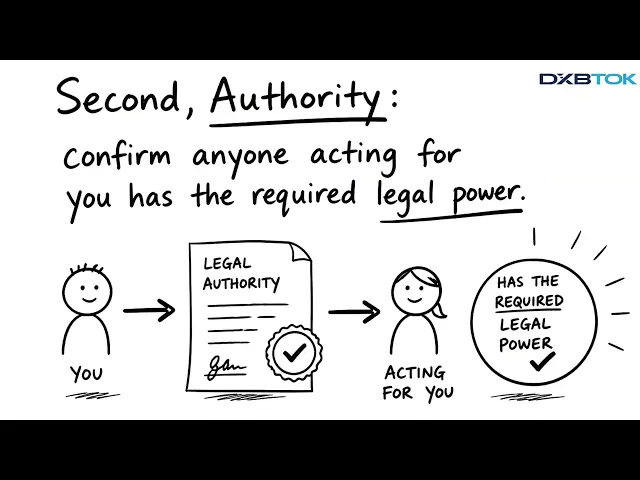
4. Keep identity and authority as two separate checks
Knowing who a person is does not automatically prove that they can act for the buyer.
A remote transaction should separately establish:
IDENTITY — Who is this person?
and
AUTHORITY — What are they allowed to do?
This distinction is especially important when documents are being exchanged across countries and several advisers or transaction parties are involved.
5. Confirm which document governs the current transaction stage
Remote buyers can receive many files through email, portals and messaging apps.
Not every document has the same legal or transaction function.
At each stage, identify the document that governs the current commitment.
This may include:
reservation documentation
the relevant purchase agreement
an amendment or addendum
representation documents
registration-related documentation
The buyer should know which document creates the current obligation instead of treating every attachment as equivalent.
6. Control document versions before signing remotely
Remote document exchange makes version control important.
A buyer may receive an initial draft, a revised draft and then a final signature version.
Before signing, confirm:
the document title
the latest version or date
the correct property
the correct buyer details
that agreed amendments are reflected
The document being signed should be the document the buyer actually reviewed.

7. Separate sales explanations from formal obligations
A remote buyer may depend heavily on calls, WhatsApp messages, email summaries and sales presentations.
These can help explain the transaction.
But an important promise or condition should ultimately be checked against the relevant formal documentation.
The buyer should know when a statement is:
marketing information
a sales explanation
a current commercial term
a contractual obligation
For the wider verification sequence around the parties, property, contract, registration and payment, review the Dubai property compliance checks for international buyers.
This prevents informal communication from silently replacing the written transaction structure.
8. Confirm how signatures or acceptances are supposed to be completed
Do not assume that clicking, emailing or signing a scanned document is automatically the correct execution method for every transaction step.
Ask what the applicable process requires for the specific document.
Confirm:
who must sign
whether both parties must sign
whether a representative may sign
whether a particular execution channel is required
how the completed document will be returned or recorded
The correct execution method depends on the document and transaction stage.
9. Keep amendments tied to the original agreement
If the transaction changes after the main agreement is signed, the buyer should know how the change is documented.
Examples can include changes to:
buyer details
payment timing
property information
other agreed transaction terms
Remote buyers should keep amendments, addenda and later formal notices together with the original agreement so the legal record remains understandable.
10. Know what registration evidence should follow the transaction stage
The buyer should understand what formal record or evidence is expected after the relevant registration step.
The exact evidence can differ between transaction types and stages.
For example, an off-plan purchase and a completed-property transfer do not necessarily produce the same document at the same time.
The important control is:
Buyers can separately review how Title Deed property ownership in Dubai works.
After a formal registration step, know what official output should exist and where it should come from.
11. Do not confuse contract signature with completed ownership
Signing a purchase agreement is an important legal step.
But it should not automatically be treated as proof that every later registration or ownership step has already been completed.
A remote buyer should distinguish between:
agreement signed
registration step submitted or completed
transaction still in progress
ownership or the relevant official registration position confirmed
This keeps the legal status of the transaction clear.
12. Keep payment evidence connected to the legal obligation
This article does not replace a payment-safety review.
But from a legal-record perspective, every material payment should still connect to the transaction.
Keep:
the document or obligation supporting the payment
the payment instruction
transfer or payment evidence
receipt or acknowledgement where provided
The purpose is to maintain a clean record showing why money was paid and how that payment fits into the purchase.
13. Confirm what happens if the buyer cannot attend a later stage
A buyer may begin the transaction expecting to attend handover or another later step and then discover that travel is not possible.
Do not wait until the deadline to solve the representation issue.
If physical attendance may be required, confirm early:
whether remote completion is possible
whether a representative can act
what authority the representative would need
what documentation must be prepared in advance
Remote execution works better when absence is planned for rather than handled as an emergency.
14. Recheck authority if the representative or transaction changes
A power of attorney or other authority should be considered in the context in which it will actually be used.
If the transaction, property, representative or required action changes, reconfirm that the existing authority still covers the intended step.
Do not assume that authority prepared for one action automatically applies to a different one.
15. Keep one controlled legal transaction file
A remote buyer should be able to reconstruct the legal side of the transaction without searching through months of scattered messages.
Keep one organised file containing:
identity documents used for the transaction
representation or authority documents where applicable
signed agreements
amendments or addenda
formal notices
payment evidence
registration-related outputs
This is not about collecting every email.
For the wider document inventory, use the Dubai property documents checklist for international buyers.
It is about preserving the documents that establish the legal chain of the purchase.
16. Pause when the legal chain stops matching
Remote buyers should be particularly careful when one part of the transaction no longer matches another.
Pause and clarify if, for example:
the buyer name changes unexpectedly
a different contracting entity appears
the representative’s authority is unclear
a new document conflicts with an earlier signed document
a registration output does not match the expected property or buyer
The correct response to a material inconsistency is verification before continuing.
17. Use a remote legal-control checklist
Before and during a remote Dubai property purchase, ask:
Is the buyer identity consistent across the transaction?
Who is performing each formal step?
If someone represents the buyer, is the authority appropriate for that step?
Which document currently governs the transaction?
Am I signing the correct and latest version?
Are sales explanations reflected where they need to be in formal documents?
Is the execution method appropriate for the document?
Are amendments connected to the original agreement?
What official registration evidence should follow?
Does each material payment connect to a documented obligation?
If I cannot attend later, is the representation plan already clear?
Can I reconstruct the legal transaction from my records?
This checklist is deliberately narrower than a full property due-diligence review.
Its purpose is to keep the remote legal execution chain clear.
Final takeaway
Remote Dubai property buying is not simply a question of whether the buyer can avoid travelling.
The legal issue is whether the transaction remains controlled when the buyer is not physically present.
Keep four things clear:
IDENTITY → AUTHORITY → GOVERNING DOCUMENT → OFFICIAL EVIDENCE
Then maintain that chain through signatures, amendments, payments and registration-related steps.
Remote does not mean informal. The buyer should always know who is acting, under what authority, based on which document and what formal evidence should follow.
Buying Dubai property remotely?
DXBTOK helps international buyers review selected Dubai property opportunities with clearer information around remote purchase steps, documentation, verification and transaction structure.
Start your Dubai property review at DXBTOK.com.
Related DXBTOK guides
Buying Dubai Property Without Visiting →
Power of Attorney for Dubai Property: What Buyers Should Know →
Dubai Property Compliance Checks for International Buyers →
Dubai Property Documents Checklist for International Buyers →