
Dubai property transactions can sometimes move quickly, but speed should change when important information stops matching. This guide explains when international buyers should pause a transaction to reconfirm the property, price, payment instructions, documents, responsible parties, funding plan or material sales claims before sending money, signing or making a larger commitment.
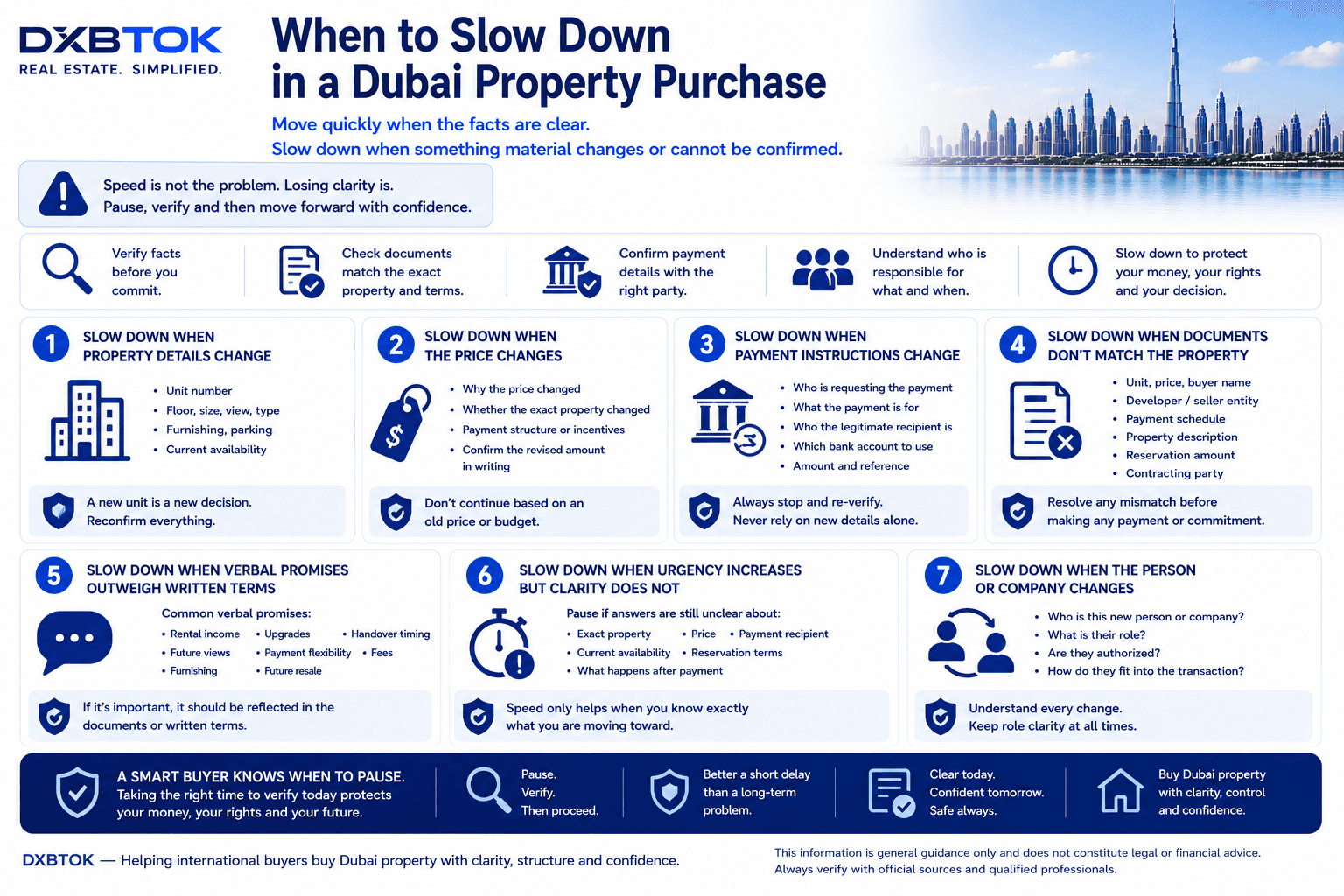
When to Slow Down in a Dubai Property Purchase
Dubai property can move quickly.
A popular unit may be reserved. A new launch may attract strong buyer interest. A seller may have several enquiries. A payment deadline may be approaching.
Speed itself is not the problem.
The problem begins when the buyer continues moving at the same speed after something important becomes unclear, changes unexpectedly or stops matching the rest of the transaction.
A useful rule is:
Move quickly when the facts are clear. Slow down when a material fact changes or cannot be confirmed.
This does not mean treating every delay, update or correction as suspicious.
It means recognising the moments when more verification is needed before the buyer sends money, signs documents or makes a larger commitment.
1. Slow down when the property details change
A buyer may begin by reviewing one specific property and later receive information about another unit.
Sometimes this is completely legitimate.
The original unit may have been reserved, sold or withdrawn.
But the buyer should notice the change.
Reconfirm:
unit number
floor
size
view or orientation
property type
furnishing status
parking allocation where relevant
current availability
Do not let a replacement property inherit the assumptions you made about the original one.
A new unit is a new decision.
2. Slow down when the price changes
Property prices can change.
Developer inventory can be repriced. Seller expectations can move. Promotions can expire. Different units in the same project can have different prices.
A changed price is not automatically a warning sign.
But the buyer should stop long enough to understand:
why the price changed
whether the exact property changed
whether the payment structure changed
whether an incentive was added or removed
whether the revised amount is confirmed in writing
Do not continue using an earlier budget calculation after the commercial terms have materially changed.
3. Slow down when the payment instructions change
This is one of the clearest pause triggers in any property transaction.
If payment instructions change, do not simply use the new details because they arrived in the same WhatsApp or email conversation.
Reconfirm:
who is requesting the payment
what the payment is for
who the legitimate recipient is
which bank account should receive it
whether the payment amount and reference are correct
The more important the payment, the stronger the verification should be.
Before sending funds, use the dedicated Dubai property payment safety checklist to verify the payment-control sequence.
A changed payment instruction should always interrupt automatic transaction momentum.
4. Slow down when a document does not match the property you selected
Documents should describe the transaction the buyer believes they are entering.
Pause if a document shows a materially different:
unit
price
buyer name
developer or seller entity
payment schedule
property description
reservation amount
contracting party
A mismatch can be an administrative error.
It can also be a sign that the buyer is looking at the wrong document version.
Either way, the correct response is the same:
resolve the mismatch before progressing.
5. Slow down when verbal promises become more important than written terms
A property conversation can include many useful explanations.
But if an important reason for buying depends on something that exists only in a verbal message, the buyer should slow down before committing.
This can include claims about:
rental income
future views
furnishing
upgrades
payment flexibility
handover timing
fees
future resale
When the sales conversation becomes a specific commercial proposal, buyers should verify the Dubai property offer before sending money.
The question is not whether the person making the statement is trustworthy.
The question is whether the point is important enough that the buyer needs to understand how it is reflected in the actual transaction information or documents.
6. Slow down when urgency increases but clarity does not
Some property opportunities genuinely move quickly.
Limited inventory can be real.
A seller may choose another buyer.
A launch allocation may close.
But urgency should normally come with increasing clarity, not decreasing clarity.
If the buyer is being asked to move faster while still receiving vague answers about:
the exact property
current availability
the price
the payment recipient
the reservation terms
what happens after payment
that is a reason to pause.
Speed is useful only when the buyer knows what they are accelerating toward.
7. Slow down when the person or company changes
A buyer may begin with one broker, one developer contact or one transaction coordinator and later be introduced to another person.
That can be completely normal.
Different people may handle sales, compliance, documentation, finance or handover.
But the buyer should understand the handover between them.
Ask:
Who is this person?
Which company or team do they belong to?
What role do they now have?
What information are they authorised to confirm?
Why has responsibility moved to them?
Do not assume that everyone added to a group chat has the same authority.
8. Slow down when the current listing no longer matches the transaction
Online listings are discovery tools.
The transaction may change after the buyer first sees the advertisement.
If the exact property, price, payment plan or availability no longer matches the original listing, the buyer should stop relying on the advertisement as the current source of truth.
Move to:
current property information
current written commercial terms
current documents
verified transaction parties
Buyers can use the dedicated process to verify the Dubai property listing before relying on it as a current purchase candidate.”
The listing helped you find the opportunity.
It should not continue controlling the decision after newer, property-specific information exists.
9. Slow down when the payment schedule no longer matches your funding plan
Sometimes the property remains attractive but the transaction timing changes.
A payment may become due earlier than expected.
A financing assumption may no longer apply.
A currency transfer may take longer than planned.
The buyer should not let emotional commitment to the property override funding reality.
Recheck:
available cash
payment deadlines
transfer limits
currency-conversion timing
mortgage or financing conditions
what happens if a payment is delayed
A property that fits the total budget may still not fit the buyer’s actual payment timeline.
10. Slow down when you cannot explain the next step yourself
This is a simple but useful test.
Before sending money or signing something important, the buyer should be able to explain:
what is happening now
why this step is required
who is responsible
what the buyer is agreeing to
what happens immediately afterwards
If the buyer cannot explain the next step in plain language, more clarification may be needed.
The transaction may still be legitimate.
But complexity should not become an excuse for proceeding without understanding.
11. Slow down when answers from different parties conflict
Remote buyers may receive information from:
a broker
a developer
a seller
a bank
a compliance team
a transaction coordinator
If two relevant parties provide materially different answers to the same transaction question, do not simply choose the answer you prefer.
Identify which party has authority to confirm that specific issue.
Then resolve the inconsistency.
Different roles can legitimately produce different perspectives.
But material transaction facts should eventually reconcile.
12. Slow down when the explanation keeps changing
One correction is not necessarily a problem.
Property transactions involve people, systems and changing inventory.
But repeated changes to the explanation should cause the buyer to reassess the quality of the information.
For example:
the reason for a payment changes
the unit changes more than once
different prices are quoted without explanation
the payment recipient changes repeatedly
the role of the intermediary becomes unclear
documents repeatedly contradict the sales explanation
The issue is not the existence of one correction.
The issue is whether the transaction remains internally consistent.
13. Slow down when a material claim cannot be supported
A property decision may depend on a claim about:
rental demand
future infrastructure
brand involvement
service levels
payment flexibility
guaranteed or projected income
completion timing
For a wider method of interpreting promotional statements, review how to read Dubai property marketing claims.
If the claim materially affects the purchase decision, ask what supports it.
The answer may be a document, official information, contractual wording, comparable evidence or a clearly identified estimate.
If no one can explain what the claim is based on, reduce the weight you give it.
14. Slow down when your own reason for buying changes
Not every pause trigger comes from the seller, developer or broker.
Sometimes the buyer changes.
You may begin looking for:
a rental property
a second home
a future relocation option
a short-term opportunity
a long-term hold
and then realise your actual objective is different.
If the reason for buying changes, reassess the property.
A property chosen for one objective should not automatically remain the right property for another.
15. Slow down when you feel you are continuing only because you have already invested time
Buyers can become committed to a property before they have legally or financially committed to it.
After weeks of calls, comparisons and document exchanges, walking away can feel like wasting effort.
That is not a good reason to continue.
The correct question remains:
“Based on what I know now, would I still choose this property and this transaction?”
Past effort should not override new information.
16. Use a simple pause test before the next commitment
Before a meaningful payment or signature, ask:
Has the property changed?
Has the price changed?
Have payment instructions changed?
Do the latest documents match the deal I understand?
Is an important claim still unsupported?
Are different parties giving conflicting information?
Can I clearly explain what happens next?
If the answers remain consistent, the buyer may be able to continue efficiently.
For the broader verification framework, use the Dubai property buyer due diligence checklist.
If one material point is unresolved, change the transaction speed from:
PROCEED
to:
VERIFY
Then continue when the issue is resolved.
17. Slowing down should have a purpose
Pausing is not the same as becoming permanently cautious.
A useful pause should answer a specific question.
For example:
confirm the current unit
confirm the price
verify the payment recipient
replace the wrong document
resolve conflicting instructions
clarify a material marketing claim
confirm that funding can arrive on time
Once that uncertainty is resolved, the transaction can move again.
The objective is not to slow every purchase.
It is to prevent momentum from carrying the buyer past an unresolved material issue.
Final takeaway
A fast Dubai property transaction is not automatically unsafe, and a slow transaction is not automatically safer.
The important question is whether the buyer adjusts speed when the facts change.
Slow down when the property, price, payment details, documents, parties or material claims stop matching what you previously understood.
Resolve the inconsistency.
Confirm the current position.
Then continue.
Good buyers do not move slowly all the time. They know when a change is important enough to interrupt momentum and verify before proceeding.
Reviewing a Dubai property purchase?
DXBTOK helps international buyers review Dubai property opportunities with a clearer structure around property information, verification, transaction steps and remote coordination.
Start your Dubai property review at DXBTOK.com.
Related DXBTOK guides
Dubai Property Payment Safety Checklist →
How to Verify a Dubai Property Offer Before Sending Money →
How to Verify a Dubai Property Listing →