Dubai property marketing may include claims about location, rental potential, starting prices, future infrastructure, amenities, branding, demand and expected returns. These statements do not all carry the same level of certainty. This guide helps international buyers classify property marketing claims, identify the evidence or assumptions behind them and decide how much weight each statement should receive before a purchase decision.
How to Read Dubai Property Marketing Claims
Dubai property marketing is designed to attract attention.
That is normal.
Brochures, listings, launch presentations, social-media advertisements and sales messages may highlight location, lifestyle, payment plans, rental potential, future infrastructure, views, amenities, branding or expected demand.
The problem begins when a buyer reads every statement as if it carries the same level of certainty.
It does not.
A useful buyer skill is learning to separate:
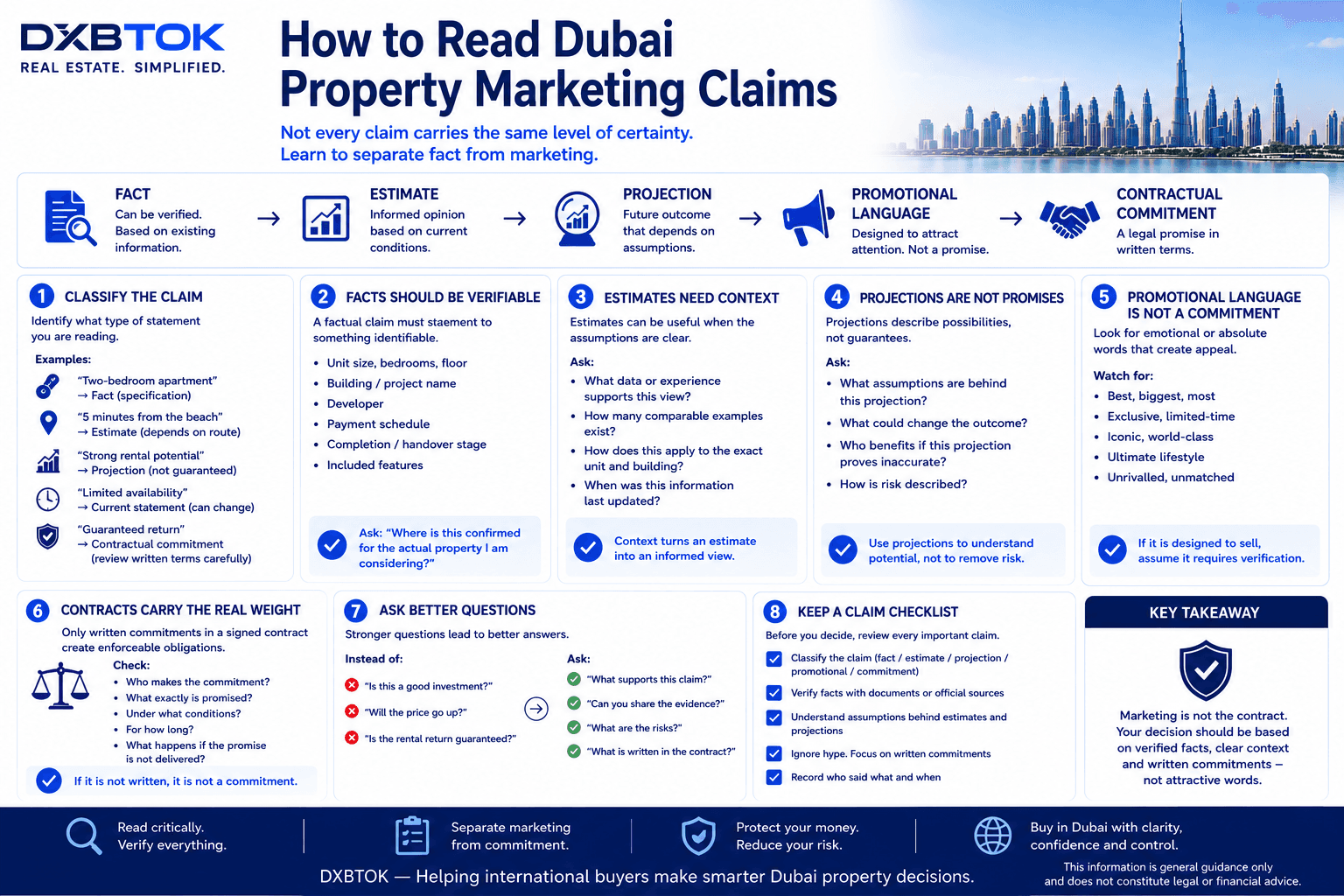
fact → estimate → projection → promotional language → contractual commitment
The purpose is not to assume that marketing is misleading.
It is to understand what each statement can reasonably prove before using it in a purchase decision.
1. Start by identifying what kind of statement you are reading
Before deciding whether a claim is persuasive, classify it.
A property advertisement may contain several different kinds of statements in the same paragraph.
For example:
“Two-bedroom apartment” may describe a property specification.
“Five minutes from the beach” may be a location claim that depends on the route and transport method.
“Strong rental potential” is an assessment rather than a guaranteed outcome.
“Limited availability” may describe current inventory but can change quickly.
“Guaranteed return” is a materially stronger claim that requires careful review of the written terms and the party making the commitment.
The wording may look equally polished.
The level of evidence required is not equal.
2. Facts should be capable of being confirmed
A factual property claim should connect to something identifiable.
Examples can include:
unit size
number of bedrooms
floor
building or project name
developer
payment schedule
stated completion or handover stage
included features
The buyer should be able to ask:
“Where is this confirmed for the actual property I am considering?”
The stronger the purchase commitment becomes, the more important it is to move from promotional material to current property-specific information and transaction documents.
3. Estimates should expose their assumptions
An estimate is not automatically unreliable.
But an estimate only becomes useful when the assumptions behind it are visible.
Examples include:
estimated rental income
projected occupancy
expected service costs
future furnishing costs
estimated completion timing
estimated resale value
Ask what the estimate is based on.
Is it using:
current comparable properties?
historical data?
a future market assumption?
a gross figure before costs?
a best-case scenario?
a developer or sales-team projection?
An estimate should help you model a possible outcome.
It should not be treated as a confirmed future result.
4. Return claims deserve a separate level of scrutiny
Statements about yield, income or return can strongly influence buyer decisions.
But similar-looking percentages can describe very different things.
A quoted figure may refer to:
gross rental yield
estimated net yield
historical performance
projected future performance
a contractual return arrangement
a temporary promotional guarantee
These should never be treated as interchangeable.
For the specialist review of stronger income promises, see why buyers should be careful with guaranteed returns in Dubai property.
Before relying on a return claim, understand who makes it, how it is calculated, what costs are excluded, what period it covers and whether it appears in binding written documentation.
5. “Starting from” is not the price of every unit
One of the most common marketing phrases in property advertising is a starting price.
For example:
“Apartments from AED…”
This can be useful for understanding the entry level of a project or campaign.
But it does not establish the price of the unit you actually want.
The advertised starting point may apply to:
a different unit type
a smaller layout
a different floor
a less desirable orientation
limited remaining inventory
a particular payment arrangement
Before treating the opportunity as current, buyers can also verify the Dubai property listing itself.”
Once you select a specific property, replace the starting-price message with the current written price for that property.
6. “Prime location” is an opinion until you define what matters
Location language is often persuasive because the words sound objective.
Terms such as:
prime
prestigious
strategic
exclusive
central
high-demand
are often positioning language rather than measurable conclusions.
A better approach is to translate the claim into specific buyer questions.
If the advertisement says “prime location,” ask:
Prime for what?
How far is it from the places I actually use?
What transport access exists?
What is already built nearby?
What is still planned?
Does the location fit rental, personal-use or resale objectives?
The word becomes useful only after the buyer defines the criteria.
7. “Minutes from” should be treated as a route claim
Travel-time claims can sound precise while depending heavily on assumptions.
“Ten minutes from Downtown” may depend on:
driving rather than walking
a particular route
light traffic
the exact starting point inside the community
future road access
The safest interpretation is not to reject the statement automatically.
It is to test the route under realistic conditions relevant to your use of the property.
8. Future infrastructure should be separated from existing infrastructure
Marketing material may highlight planned roads, transport links, schools, retail, beaches, hotels, community facilities or neighbouring developments.
Future infrastructure can matter.
But a planned feature and an operating feature are not the same thing.
Ask:
Does it already exist?
Is it under construction?
Has it been formally announced?
Is the completion date confirmed or indicative?
How important is it to my purchase decision?
A buyer should be careful about paying today for a future benefit that remains uncertain.
9. Renders show an intended product, not a completed property
Off-plan marketing relies heavily on visual material.
Renders can help a buyer understand the intended architecture, interiors, landscaping and atmosphere.
But a render is not physical evidence that the finished property will appear exactly the same in every detail.
Buyers should distinguish:
artist impressions
show-unit images
actual completed-property photographs
community photographs
indicative furniture or décor
The closer the buyer moves toward purchase, the more important the contractual specifications and official project documents become.
10. “Fully furnished” still needs a definition
A property may be marketed as furnished, fully furnished or turnkey.
Those words can mean different things between projects.
Ask what is actually included.
For example:
major furniture
appliances
lighting
curtains or blinds
decorative items
kitchen equipment
televisions
outdoor furniture
A furnishing claim becomes useful when it connects to an inventory or specification rather than a general description.
11. Brand names should be separated from the exact contractual relationship
A recognised brand can materially influence how buyers perceive a project.
But the presence of a brand name in marketing should lead to more precise questions.
For example:
What is the brand’s role?
Is it a branded residence, hospitality relationship, management arrangement or another form of association?
Which entity is developing the property?
Which entity operates or manages relevant services?
What obligations are reflected in the buyer documentation?
The brand is part of the property proposition.
For branded projects, use the dedicated process to verify branded residence claims in Dubai.
The buyer still needs to understand what the brand relationship actually delivers.
12. “Limited availability” should trigger confirmation, not panic
Real property inventory can be limited.
Popular units can sell or become reserved quickly.
But urgency should never remove the need to confirm what is actually available.
If a buyer is told only a few units remain, ask for the current options relevant to the buyer’s requirements.
The goal is not to challenge every urgency statement.
It is to prevent urgency from replacing information.
Speed is useful after the important facts are clear.
13. “High demand” needs a defined market
A statement that an area or project has high demand may refer to different things.
It could mean:
strong buyer interest at launch
rental enquiries
short-term rental activity
resale transactions
limited supply of a particular unit type
general popularity of the wider area
These are different forms of demand.
Ask what demand is being referred to and whether that demand is relevant to the exact property and buyer objective.
14. Marketing comparisons should use the same basis
A property may be described as cheaper, higher yielding, more exclusive or better located than another opportunity.
Comparison claims are only useful when both sides are being compared using the same assumptions.
For example, compare:
similar property types
similar sizes
similar completion stages
similar furnishing assumptions
similar cost treatment
similar rental assumptions
For the purchase-side calculation, review the full cost of buying Dubai property separately from the marketing headline.
A headline comparison can become misleading when one property is shown using gross figures and another using net figures, or when one price includes features that the other excludes.
15. Separate marketing claims from contractual commitments
This is the most important distinction in the entire process.
A brochure, advertisement, presentation or sales message helps explain and promote the property.
A contractual commitment is something different.
As the buyer moves toward reservation and purchase, confirm which important points appear in the relevant written transaction documents.
Do not assume that every marketing statement automatically becomes a contractual obligation.
When the property moves from marketing into a specific commercial proposal, the next step is to verify the Dubai property offer before sending money.
When a claim materially affects why you are buying the property, make sure you understand how that point is documented before committing.
16. Use a simple five-question claim test
Whenever a marketing statement affects your decision, ask:
What exactly is being claimed?
Is it a fact, estimate, projection or promotional opinion?
What evidence or assumption supports it?
Does it apply to the exact property I am considering?
Does it appear in the relevant written transaction documents if it is important to the purchase?
This turns marketing analysis into a repeatable buyer process.
17. Good marketing and good due diligence can coexist
Property marketing is not the enemy of careful buying.
Buyers need marketing to discover projects, understand positioning and identify opportunities worth investigating.
The mistake is asking marketing material to perform a job it was not designed to perform.
Use marketing to discover.
Use verification to confirm.
Use documents to understand the transaction.
Use your own objectives to decide.
Final takeaway
Dubai property marketing claims should not all be accepted, rejected or interpreted in the same way.
A stronger buyer learns to classify the statement first.
Facts should be confirmable.
Estimates should reveal their assumptions.
Return claims require deeper scrutiny.
Promotional language should be translated into measurable buyer questions.
And any claim that materially affects the purchase should eventually be compared with the property-specific information and relevant written documents.
Do not ask whether the marketing sounds convincing. Ask what type of claim it is, what supports it and how much weight it deserves in your decision.
Reviewing Dubai property opportunities?
DXBTOK helps international buyers review selected Dubai property options with a more structured approach to property information, verification and purchase decisions.
Start your Dubai property review at DXBTOK.com.
Related DXBTOK guides
How to Verify a Dubai Property Listing →
Guaranteed Returns in Dubai Property: Why Buyers Should Be Careful →
How to Verify Branded Residence Claims in Dubai Before Buying →
Full Cost of Buying Dubai Property: What International Buyers Should Budget →