Dubai Buyer KYC Checks Explained: What International Property Buyers Should Expect


KYC is a normal part of many Dubai property transactions and can involve more than simply providing a passport. This guide explains how buyer identity is verified, why transaction parties may ask about beneficial ownership and source of funds, how corporate and remote buyers can face additional checks, and how international buyers can prepare their documents early to reduce avoidable delays.
Dubai Buyer KYC Checks Explained: What International Property Buyers Should Expect
When buying property in Dubai, international buyers may be asked to complete KYC checks before a transaction can move forward.
KYC means Know Your Customer. In practical terms, it is the process used by regulated businesses and transaction partners to confirm who the buyer is, understand who ultimately controls the transaction and check whether the proposed purchase is consistent with the information provided.
For most buyers, KYC is not a sign that something is wrong. It is a normal part of modern property, banking and anti-money-laundering controls.
The easiest way to handle it is to prepare accurate documents early and answer requests consistently.
1. KYC Starts With Confirming Your Identity
The first step is usually straightforward: the party handling the transaction needs to know who the buyer is.
Depending on the transaction and whether you are resident in the UAE, you may be asked for identification such as:
Emirates ID
valid passport
residency details where applicable
current contact information
Dubai Land Department’s completed-property sale-registration process currently accepts Emirates ID for residents and a valid passport for non-resident foreign buyers.
2. Your Details Should Match Across the Transaction
KYC becomes harder when names, addresses, passport details or buyer information are inconsistent across different documents.
Before submitting anything, check that the same buyer details appear correctly on:
reservation documents
sale agreements
payment records
banking documents
mortgage documents where applicable
registration information
Our Dubai property documents checklist for international buyers can help you organise the wider document file.
3. KYC May Go Beyond a Passport Check
Identity verification is only one part of customer due diligence.
Depending on the risk profile and the parties involved, additional questions may be used to understand:
the purpose of the purchase
the buyer’s occupation or business activity
the expected source of the purchase funds
whether another person is acting behind or controlling the transaction
whether the buyer is acting for themselves or for another party
The exact level of information requested can vary by transaction and by the regulated party carrying out the checks.
4. Source-of-Funds Questions Are Different From Proof of Identity
A buyer can have perfectly valid identification and still be asked where the purchase money comes from.
Source-of-funds checks are designed to understand the origin of the money used for the transaction.
Depending on the circumstances, supporting evidence may include records relating to:
salary or business income
savings
sale of another property
investment proceeds
inheritance
loan or mortgage proceeds
Not every buyer will be asked for the same documents. The request should match the transaction and the source being declared.
5. Keep the Money Trail Consistent With the Buyer
If the purchase funds come from a bank account or person that does not obviously match the buyer, additional questions may follow.
That does not automatically prevent the transaction, but the relationship and payment purpose may need to be explained clearly.
For the payment-control side, use our Dubai property payment safety checklist.
6. Corporate Buyers Usually Need More Ownership Information
When the buyer is a company or other legal structure, KYC is generally more detailed than for an individual buyer.
The parties carrying out customer due diligence may need to understand:
the company’s legal identity
licence or registration details
ownership and control structure
directors or authorised signatories
the natural person who ultimately owns or controls the entity
This is often referred to as identifying the beneficial owner.
7. Beneficial Ownership Means Looking Behind the Company Name
If a company is purchasing the property, simply knowing the company name may not be enough.
Customer due diligence can require reasonable steps to identify the natural person who ultimately owns or controls the buyer.
Complex structures, nominee arrangements or unexplained third-party involvement can lead to additional questions.
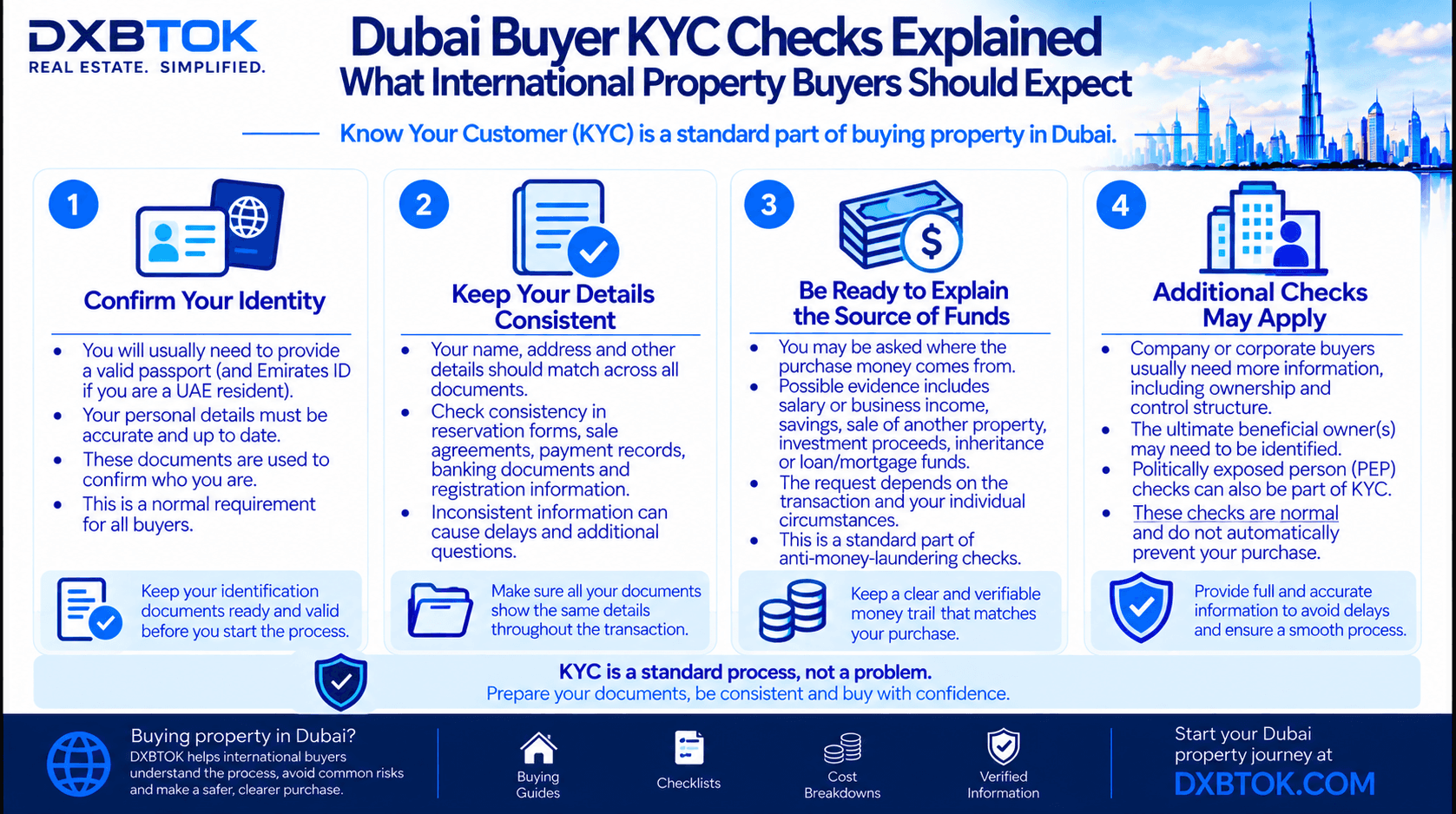
8. Politically Exposed Person Checks May Be Part of KYC
Regulated businesses may also screen customers for politically exposed person status.
A politically exposed person, often shortened to PEP, is someone who holds or has held a prominent public function, with related rules also extending to certain family members and close associates.
Being identified as a PEP does not automatically mean a property purchase cannot proceed.
It can mean that enhanced checks or additional approval may be required.
9. Sanctions Screening Is a Separate Part of the Review
Real estate professionals subject to anti-money-laundering obligations may screen customers against applicable sanctions lists.
This is different from checking whether the property itself is genuine or whether the broker is licensed.
For the wider transaction-verification sequence, see our Dubai property compliance checks for international buyers.
10. Remote Buyers Should Expect Identity Checks to Be Taken Seriously
Buying from abroad does not remove KYC requirements.
Non-face-to-face transactions can require careful identity verification because the buyer is not physically present with the party carrying out the checks.
That makes it useful to prepare clear digital copies of documents and respond quickly to verification requests.
Our Dubai remote buying guide explains the wider practical process of purchasing from abroad.
11. Do Not Send Sensitive Documents to Unverified Contacts
KYC requires personal information, so buyers should confirm who is requesting it before sending passports, IDs, bank statements or financial records.
Check:
the company or regulated party requesting the information
the email address or secure upload channel
why the document is required
whether the request relates to the actual transaction
Do not send sensitive records simply because someone contacts you through an informal messaging channel.
12. Different Parties May Run Their Own Checks
A property transaction can involve several regulated or commercial parties.
Depending on the structure, a buyer may face separate checks from:
a real estate brokerage
a developer
a bank or mortgage provider
a payment provider
a registration or trustee process
One party completing KYC does not necessarily mean every other party will rely on the same file.
13. KYC Can Happen More Than Once
Customer due diligence is not always a one-time form completed at the start.
If the transaction changes materially, new information appears or the relationship continues over time, updated information may be requested.
Keep your identification and supporting documents current while the purchase is active.
14. Large or Unusual Transactions Can Trigger More Questions
The amount and structure of the transaction can affect the level of review.
Additional questions may arise where:
the transaction is unusually large for the buyer profile
several third parties are involved
funds come from multiple jurisdictions
the ownership structure is complex
the payment route changes unexpectedly
the transaction does not have an obvious commercial explanation
The practical response is to provide a clear and documented explanation rather than trying to avoid the question.
15. KYC Is Not the Same as Property Due Diligence
KYC checks the buyer and the transaction relationship.
Property due diligence checks the property, project, seller, developer, documents and commercial facts surrounding the purchase.
Both matter, but they answer different questions.
16. KYC Is Also Not the Same as the Full Buying Process
KYC can appear at several stages, but it is only one part of the transaction.
The full purchase still involves property selection, verification, reservation, contract review, payment, registration and completion.
For the overall sequence, see our Dubai property buying process guide.
17. Avoid These Common KYC Mistakes
Submitting an expired passport.
Using different names or spellings across documents.
Sending funds from an unexplained third-party account.
Waiting until the payment deadline to prepare source-of-funds evidence.
Ignoring requests for beneficial-owner information when buying through a company.
Assuming a previous KYC check will automatically satisfy every other party.
Sending sensitive documents to an unverified person or informal account.
18. Prepare a Simple Buyer KYC File
International buyers can reduce delays by keeping a basic file ready.
Depending on the transaction, that file may include:
valid passport
Emirates ID where applicable
current address and contact details
occupation or business information
source-of-funds evidence where requested
company and beneficial-owner documents where applicable
reservation or purchase documents
payment records
The exact requirement should always be confirmed with the party carrying out the KYC check.
19. Use a KYC Readiness Checklist
Identity: Is my passport or Emirates ID valid and current?
Consistency: Do my details match across all property and banking documents?
Buyer structure: Am I buying personally or through a company?
Beneficial owner: If a company is buying, is the ultimate owner clearly documented?
Purpose: Can I clearly explain the purpose of the purchase?
Funds: Can I explain where the purchase money comes from if asked?
Payment route: Does the account sending the money make sense for the transaction?
Remote purchase: Are my digital identity documents ready for non-face-to-face checks?
Security: Have I verified who is requesting sensitive documents?
Timing: Have I prepared the likely KYC file before the next transaction deadline?
Final Takeaway
KYC is a normal part of many Dubai property transactions, especially for international buyers.
The process can involve more than showing a passport. Depending on the transaction, regulated parties may also need to understand the buyer, the beneficial owner, the purpose of the purchase and the source of funds.
Keep your identity documents current, make sure the buyer and payment trail are consistent, prepare supporting records early and respond clearly when additional KYC information is requested.
Need help organising the information around a Dubai property purchase? DXBTOK can help international buyers structure the property and transaction information before moving forward.
Start your Dubai property review at DXBTOK.com.
Related DXBTOK guides
Dubai Property Documents Checklist for International Buyers →
Dubai Property Compliance Checks for International Buyers →
Buying Dubai Property Remotely →