Buying a branded residence in Dubai can involve additional layers beyond the standard property purchase, including the developer, brand or operator relationship, branded services, management arrangements, recurring costs and use conditions. This guide explains the purchase journey for international buyers from initial project selection and brand verification through unit confirmation, reservation, contract review, payments, completion and ownership.
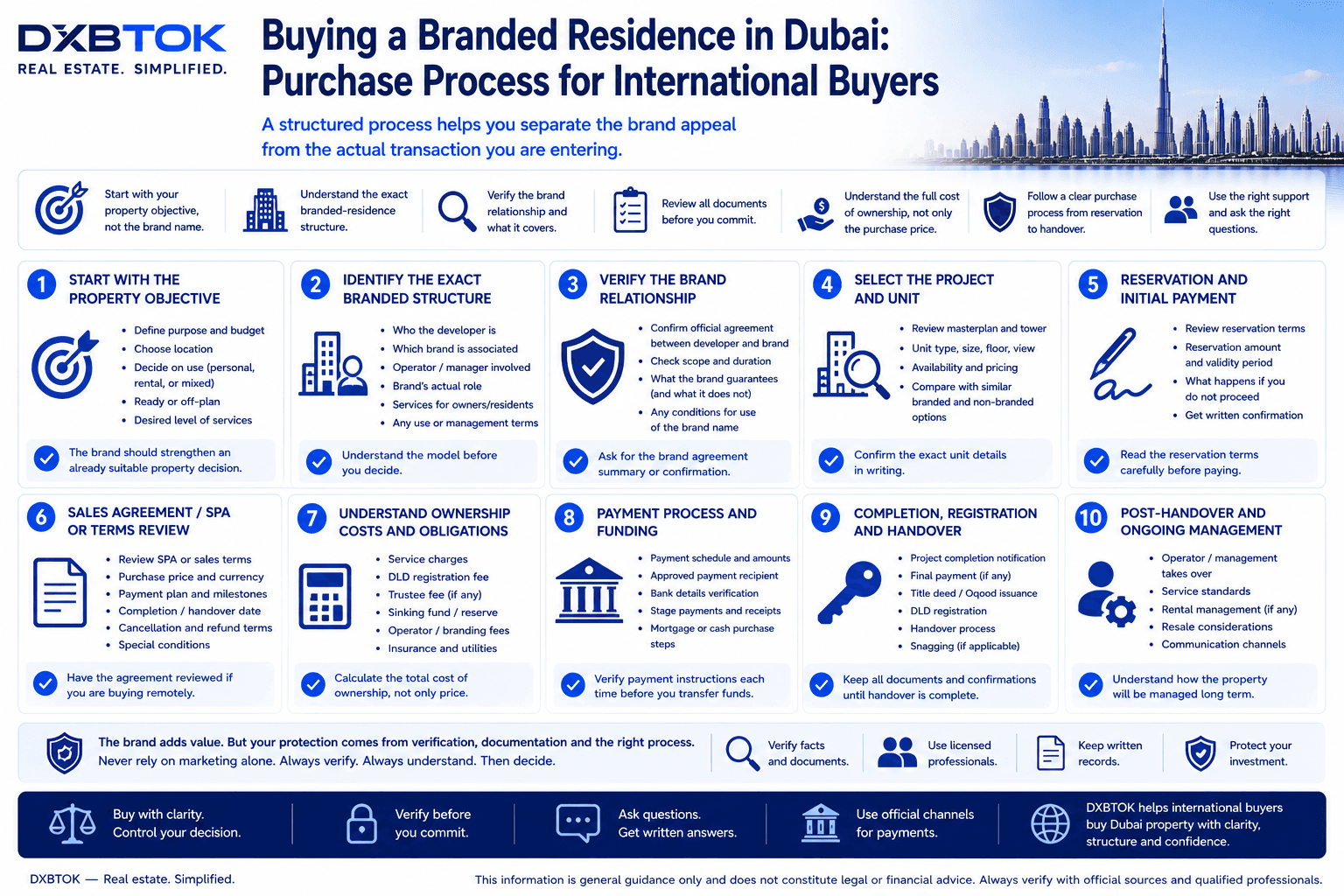
Buying a Branded Residence in Dubai: Purchase Process for International Buyers
Buying a branded residence in Dubai can involve more than choosing a luxury apartment with a recognised name attached to it.
The buyer is still purchasing property, but the decision may also involve a developer, a brand or operator, branded services, management arrangements, use conditions and additional ownership costs.
For an international buyer, the practical question is not only:
“Do I like this branded residence?”
It is:
“Do I understand the property, the branded relationship and the purchase process well enough to proceed?”
A structured process helps separate the marketing appeal of the brand from the actual transaction the buyer is entering.
1. Start with the property objective, not the brand name
A strong brand can attract attention quickly.
But the brand should not replace the buyer’s normal property-selection criteria.
Start with the same questions you would ask for any serious Dubai property purchase:
What is the property for?
What is the total budget?
Which location fits the buyer’s needs?
Is the property for personal use, rental use, a mixed objective or long-term ownership?
Does the buyer prefer ready property or off-plan?
What level of ongoing services does the buyer actually want?
The brand should strengthen an already suitable property decision.
It should not be the only reason the property is considered.
2. Identify the exact branded-residence structure
Branded residences do not all follow one identical model.
The relationship between the property, developer, brand and operator can differ from project to project.
Before moving further, understand:
who the developer is
which brand is associated with the project
whether an operator or manager is involved
what role the brand actually has
which services are intended for owners or residents
whether there are specific use or management arrangements
The buyer should understand the structure behind the name rather than assuming that every branded project offers the same relationship.
3. Verify the project and the brand relationship
A recognised brand can create confidence, but buyers should still verify the project itself.
The useful questions are:
Is the project genuine and identifiable?
Who is developing it?
What is the relationship between the developer and the brand?
What role does the operator or manager have?
Which branded features or services are actually connected to the project?
Marketing language should eventually connect to project-specific evidence and written transaction information.
The objective is not to challenge the existence of the brand relationship by default.
Before relying on the project’s branded positioning, buyers can verify branded residence claims in Dubai.
It is to know what that relationship means for the specific property being purchased.
4. Select the exact unit before treating the opportunity as final
Project-level information is useful for deciding whether a development deserves attention.
But the buyer ultimately needs to assess a specific property.
Confirm:
unit number
floor
size
layout
view or orientation
balcony or terrace where relevant
parking allocation where relevant
furnishing position
current price
current availability
A branded-residence purchase should move from:
“I like this project”
to:
“I understand this exact unit and its current commercial terms.”
5. Reconfirm the current commercial terms
Once the buyer has selected a specific unit, replace broad marketing information with the current terms for that property.
Confirm:
purchase price
reservation amount
payment schedule
any incentives
included furniture or packages
expected completion or handover stage
what ongoing fees are expected
Do not assume that the starting price, launch offer or example payment plan shown in earlier marketing still applies to the exact unit.
6. Understand what the reservation actually does
Reservation is usually an early transaction step, not the completion of the purchase.
Before paying a reservation amount or signing a reservation form, understand:
which exact unit is being reserved
the amount being paid
how that amount is treated
what happens next
which documents follow
which deadlines become relevant
what conditions apply if the transaction does not continue
The reservation stage should reduce uncertainty, not create more of it.
7. Review the main property agreement
After reservation, the buyer may move into the main contractual stage.
The exact documents can depend on the property and transaction structure.
The buyer should understand the key commercial and property terms that appear in the relevant agreement, including matters such as:
buyer and seller or developer details
exact property description
purchase price
payment obligations
completion or handover provisions
buyer and developer obligations
default or termination provisions
This is the point where the buyer should stop relying on sales conversations alone and understand what the written agreement actually says.
8. Review branded or management-related agreements separately
A branded residence may involve documents or contractual terms beyond the core property purchase agreement.
Depending on the structure, the buyer may need to understand:
brand-related obligations
management arrangements
service standards
use restrictions
rental or letting arrangements
operator responsibilities
termination or change provisions
owner obligations connected to the branded model
Do not assume that the brand name itself explains these terms.
For the deeper contractual review, see branded residence contracts in Dubai.
The buyer should understand what the relevant agreements actually create.
9. Separate the purchase price from the ownership-cost structure
The headline purchase price is only one part of the buyer’s financial decision.
Branded residences can involve recurring costs connected to services, management, amenities, operating standards or the broader branded model.
The buyer should identify:
standard service charges
management-related fees where applicable
brand or operator-related charges where applicable
maintenance obligations
furnishing or replacement requirements where relevant
rental-management charges where relevant
A premium purchase price and a premium ownership-cost structure are different questions.
Buyers should also review the dedicated guide to branded residence fees and ownership costs in Dubai.
Both should be understood before the buyer commits.
10. Check whether use restrictions affect the buyer’s objective
Some branded properties may include conditions affecting how the property is used, managed, rented, furnished or maintained.
This can matter greatly depending on the buyer’s purpose.
A buyer planning to live in the property may care about different restrictions from an owner planning to rent it.
Ask whether there are rules affecting:
short-term rental use
long-term rental use
management participation
furniture standards
alterations
owner access
use of branded services
A branded model only fits the buyer if the operating rules fit the buyer’s intended use.
11. Confirm who is responsible for each part of the transaction
A branded-residence purchase can involve several parties.
These may include:
the developer
the developer’s sales team
a licensed broker or agent
the brand
an operator or manager
transaction or compliance teams
The buyer should know who can actually confirm each important point.
For example, one party may explain the project while another controls the official inventory, contractual documents, payment instructions or operational services.
Role clarity prevents the buyer from treating every sales explanation as if it came from the same authority.
12. Verify payment instructions before transferring funds
The branded nature of the project does not remove the need for normal payment discipline.
Before transferring funds, confirm:
what the payment is for
which document supports it
who should receive the money
the correct bank details
the payment reference
how payment will be acknowledged
Do not assume that a recognised brand name makes every payment instruction automatically correct.
For the wider control sequence, review the Dubai property payment safety checklist before transferring funds
The payment must still connect clearly to the actual transaction.
13. Keep a transaction file as the purchase progresses
International buyers benefit from maintaining a simple transaction record.
Keep the latest versions of:
unit details
price and payment schedule
reservation documents
purchase agreements
brand or management-related documents
payment confirmations
important written confirmations
handover or completion updates
This makes it easier to identify when something changes and prevents outdated information from remaining in circulation.
14. Track the project through construction or completion
For off-plan branded residences, the purchase journey continues long after the reservation and contract stages.
The buyer should maintain visibility over:
construction or project updates
upcoming payment obligations
document requests
completion or handover communication
final payment requirements
inspection or snagging steps where relevant
The brand relationship may remain important, but the buyer is still moving through a property-development and completion process.
15. Reconfirm the final ownership and operating position before handover
As completion approaches, the buyer should understand what changes from purchaser to owner.
Confirm:
remaining payment obligations
handover requirements
ownership or registration steps
service-charge position
management arrangements
utility or access requirements
rental or occupancy procedures where relevant
The objective is to avoid discovering important ownership obligations only after the property is ready.
16. Do not let brand prestige replace normal buyer due diligence
A recognised brand can be a meaningful part of the property proposition.
But the buyer still needs to understand:
the property
the developer
the exact brand relationship
the contracts
the ownership costs
the payment process
the operating rules
The strongest branded-residence purchase is not the one with the most impressive logo.
It is the one where the buyer understands what is being purchased and how the branded structure affects ownership.
17. Use a branded-residence purchase sequence
A practical international-buyer sequence is:
Define the buyer objective.
Select the project.
Verify the developer and brand relationship.
Select the exact unit.
Confirm current price and commercial terms.
Review the reservation conditions.
Review the property purchase agreement.
Review branded or management-related agreements.
Confirm fees and ongoing ownership costs.
Verify payment instructions before each transfer.
Track construction or completion.
Prepare for handover, ownership and operating responsibilities.
For the wider category overview, review the Dubai branded residences buyer guide.
This keeps the buyer focused on the actual purchase journey rather than treating the branded residence as a purely lifestyle product.
Final takeaway
Buying a branded residence in Dubai is still a property transaction, but the branded structure can add another layer to what the buyer needs to understand.
International buyers should move from project interest to a clear purchase process:
select → verify → confirm unit → reserve → review agreements → confirm costs → pay carefully → complete → understand ownership
The brand may add services, operating standards, recognition or a particular ownership experience.
But the buyer should still understand the exact property, the contractual structure, the recurring costs and the responsibilities of each party.
Buy the property because the full structure makes sense — not because the brand name alone feels reassuring.
Considering a branded residence in Dubai?
DXBTOK helps international buyers review selected Dubai property opportunities, compare branded-residence options and move toward the next transaction step with clearer property, cost and verification information.
Start your Dubai property review at DXBTOK.com.
Related DXBTOK guides
Branded Residences Dubai Buyer Guide →
How to Verify Branded Residence Claims in Dubai Before Buying →
Branded Residence Contracts in Dubai: What Buyers Should Review →
Hidden Fees and Ownership Costs in Dubai Branded Residences →