Off-Plan vs Ready-to-Move in Dubai: Which Fits Your Strategy?
DXBTOK Research
Dubai Real Estate Research & Operations
Sep 10, 2025
The better option is not “off-plan” or “ready” in general—it’s the one that fits your real objective. This guide breaks down how both property types work in Dubai, where each can be stronger, and the trade-offs buyers often underestimate before committing funds.
Start with the simple difference
Off-plan means buying a property before construction is completed, usually directly from a developer. Delivery happens later, based on the project timeline.
Ready-to-move means the unit is already completed and can be occupied or rented soon after the purchase process is finalized.
That sounds simple—but the choice changes your cash flow, timeline, and risk profile.
Why many buyers choose off-plan
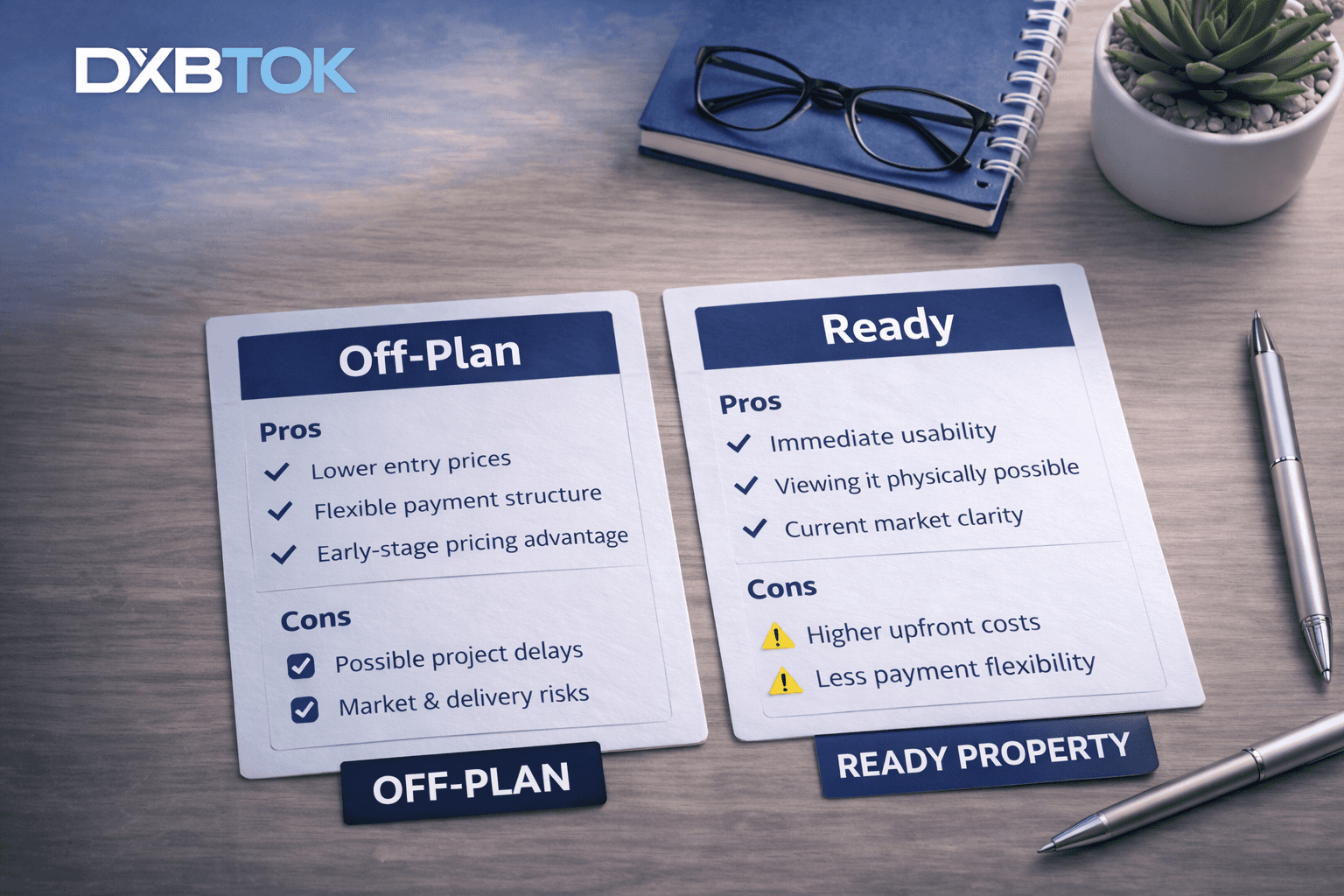
Off-plan units are often attractive because they can offer a lower entry point compared to similar completed units in the same market cycle.
They may also come with:
lower initial payment requirements
staged payment plans
time to spread capital across multiple commitments
exposure to neighborhood growth as projects and infrastructure mature
For buyers planning ahead (not needing immediate use), this structure can be practical.
The trade-offs of off-plan (the part people skip)
Off-plan is not “cheap ready property.” It is a different type of commitment.
The main risks are:
delivery delays (timeline shifts happen)
market changes during construction
developer execution risk (quality, pace, completion performance)
uncertainty between purchase decision and handover reality
This is why developer research and document checks matter more than the marketing brochure.
Why some buyers prefer ready-to-move units
Ready properties win on clarity.
You can usually:
inspect the actual unit (or exact building/condition)
evaluate the surrounding area as it exists today
understand current market pricing more directly
use the property sooner (self-use or rental setup)
For buyers who value certainty and immediate usability, ready units often feel more comfortable.
The trade-offs of ready properties
Ready units usually require more capital upfront and often come with less payment flexibility than off-plan launches.
Typical friction points:
higher initial cash requirement
fewer installment-style payment options
less “early stage” pricing advantage compared to buying earlier in a project cycle
So while risk may feel lower in some areas, cash pressure can be higher.
A practical way to choose (without overthinking)
The best choice usually comes down to three questions:
1) What is your timeline?
Need immediate use or rental setup? → Ready may fit better
Can wait for delivery? → Off-plan may be suitable
2) What is your cash flow strategy?
Prefer staged payments over time? → Off-plan
Comfortable with higher upfront deployment? → Ready
3) What is your risk tolerance?
Lower tolerance for delays/uncertainty? → Ready
Comfortable with construction timeline risk for potential pricing advantage? → Off-plan
The DXBTOK view: compare process, not just price
A lower headline price does not automatically mean a better fit. The stronger decision usually comes from comparing:
total cost structure
timeline realism
documentation quality
developer or property-specific checks
how the purchase fits your broader plan
In other words: choose the structure that matches your strategy—not the one with the best sales pitch.
Key takeaways (bullets)
Off-plan = buy before completion; delivery happens later.
Ready-to-move = completed unit with immediate usability potential.
Off-plan may offer lower entry pricing + flexible payment plans, but comes with delay/execution risk.
Ready property offers more clarity + immediate use, but often needs more upfront capital.
The right choice depends on timeline, cash flow, and risk tolerance.
Compare the process, not just the brochure
Marketing can make both options look perfect. The real difference appears in timelines, payment structure, and what can be verified before you commit.
Clarity first, then commitment
Whether a buyer chooses off-plan or ready, a good process starts with documentation, realistic assumptions, and a clear understanding of trade-offs before any funding step.